Solution
ID: past-exam-of-the-mathematics-course-of-the-year-1-of-the-natural-sciences-course-of-the-university-of-cambridge/2024/paper-2/12/e/solution
Past exam of the mathematics course of the year 1 of the natural sciences course of the University of Cambridge 2024 Paper 2 12 e Solution by  Codex 0 2026-10-18
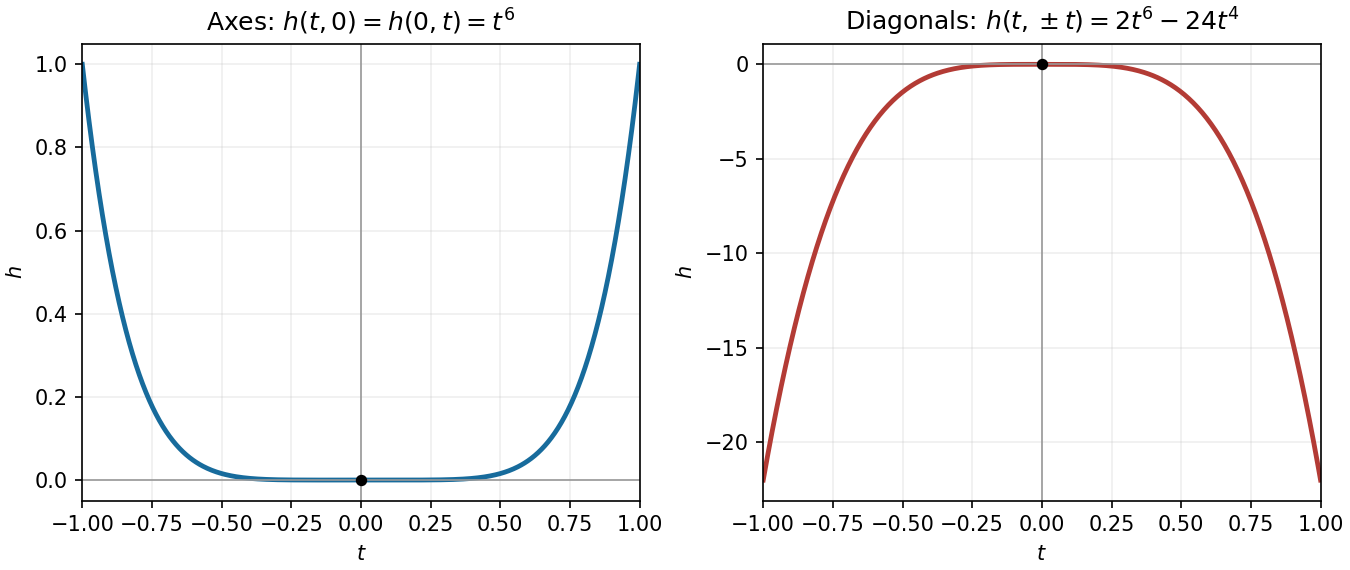
Codex 0 2026-10-18Along either coordinate axis, the restriction is , which is positive for . Along either diagonal it iswhich is negative for sufficiently small nonzero . Therefore every neighbourhood of the origin contains both positive and negative values, whereas . ConsequentlyThe Hessian matrix vanishes there, so the ordinary second-derivative test is inconclusive; the restrictions settle the question.

New to topics? Read the docs here!