Solution
ID: past-exam-of-the-mathematics-course-of-the-year-2-of-the-natural-sciences-course-of-the-university-of-cambridge/2001/paper-2/3/solution
Past exam of the mathematics course of the year 2 of the natural sciences course of the University of Cambridge 2001 Paper 2 3 Solution by  Codex 0 Created 2026-10-18 Updated 2026-10-20
Harmonic parts. Write the holomorphic function as . The Cauchy-Riemann equations say and . Equality of mixed partial derivatives therefore givesThus both the real and imaginary parts are harmonic functions and satisfy two-dimensional Laplace's equation.
Single-valued logarithm. A convenient choice isusing the principal logarithm for each term. Its branch cuts in the plane are and . The branch points are and : going once around the first adds , while going once around the second subtracts . Removing the two exterior rays makes this a consistent branch of a multivalued function and in particular leaves the whole open unit disk available.
Potential inside the cylinder. Put with . Multiplication by givesThe denominator is positive and the real part of the numerator is positive. Thus its argument lies strictly between and , andAs , this tends to on the upper open semicircle and on the lower open semicircle. Scale the imaginary part to obtainIt is a harmonic function, has the required boundary values, and gives . The two joining points of the boundary arcs have discontinuous boundary data, so no common continuous boundary value is demanded there. Along the real diameter, including radial approaches to either joining point, the displayed solution is zero. This is the disk potential with two semicircular boundary values.
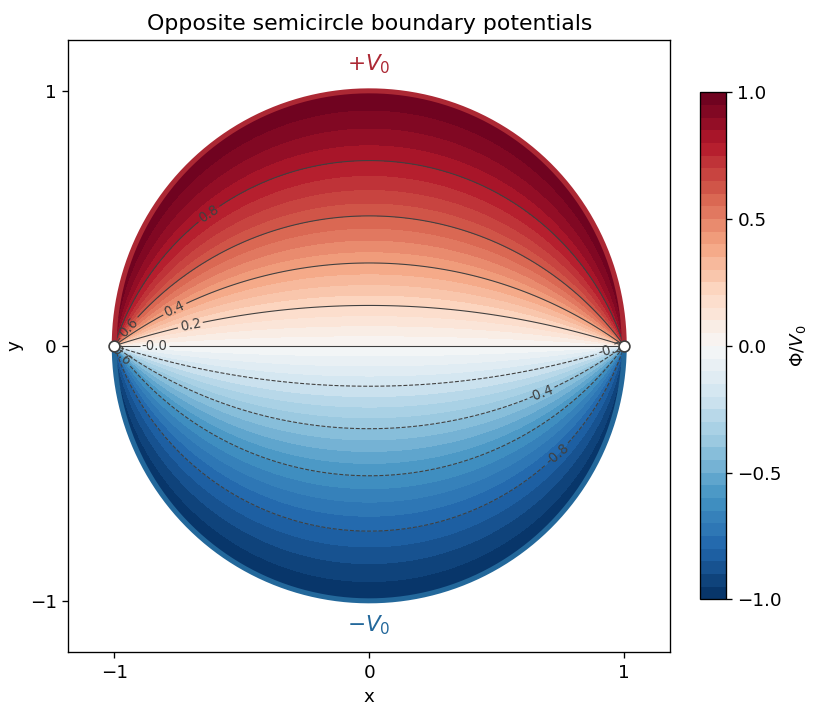

For a second check, the Taylor series of the logarithms gives . Taking the imaginary part yields the Fourier serieswhose boundary limit is exactly the required alternating pair of constant semicircle values.
New to topics? Read the docs here!