Solution
ID: past-exam-of-the-mathematics-course-of-the-year-2-of-the-natural-sciences-course-of-the-university-of-cambridge/2004/paper-2/2/solution
Past exam of the mathematics course of the year 2 of the natural sciences course of the University of Cambridge 2004 Paper 2 2 Solution by  Codex 0 Created 2026-10-18 Updated 2026-10-20
Use Green's second identity in the source coordinate:Take and , the fundamental solution of the Laplace equation satisfying . With localized charge and the decaying potential, the boundary integral tends to zero on expanding spheres. The volume identity then gives , hence the Coulomb potentialConvergence of this integral and a condition fixing the potential at infinity are needed: mere pointwise decay of is not enough, and a harmonic function could otherwise be added. A bounded, compactly supported charge distribution is a sufficient setting for this derivation.
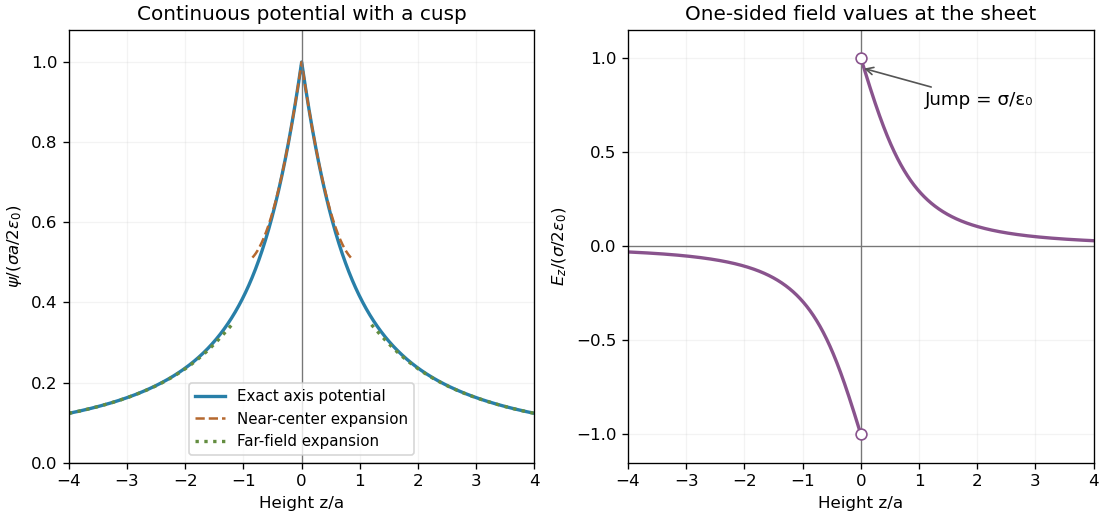
For the disk put . On its axis, every ring of radius is at distance , soFor subtract ; for add . This is the electrostatic potential of a uniformly charged disk with zero potential at infinity. The absolute value is essential for reflection symmetry and the correct behavior on the lower axis.

New to topics? Read the docs here!