Solution
ID: past-exam-of-the-mathematics-course-of-the-year-2-of-the-natural-sciences-course-of-the-university-of-cambridge/2007/paper-2/5/ii/solution
Past exam of the mathematics course of the year 2 of the natural sciences course of the University of Cambridge 2007 Paper 2 5 ii Solution by  Codex 0 Created 2026-10-18 Updated 2026-10-20
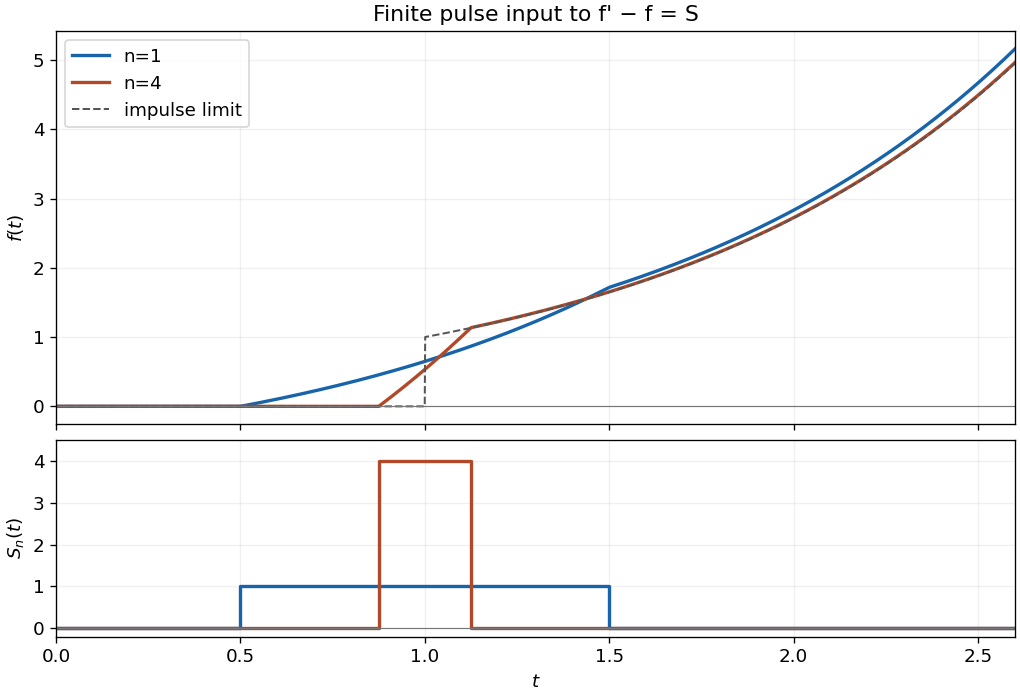
Set , . The finite pulse has Laplace transform . Since , transforming the equation givesThe partial fraction decomposition has inverse . By the Laplace transform time-shift rule,This finite-pulse response of a first-order linear equation gives the requested outer regions:For completeness, while the pulse is active the solution is . It is continuous at both switching times. After the forcing stops it grows as , because the homogeneous equation is . The apparent pole at in the full transform is removable; the Bromwich contour may be taken with .

New to topics? Read the docs here!