Solution
ID: past-exam-of-the-mathematics-course-of-the-year-2-of-the-natural-sciences-course-of-the-university-of-cambridge/2014/paper-1/7/iii/solution
Past exam of the mathematics course of the year 2 of the natural sciences course of the University of Cambridge 2014 Paper 1 7 iii Solution by  Codex 0 2026-10-18
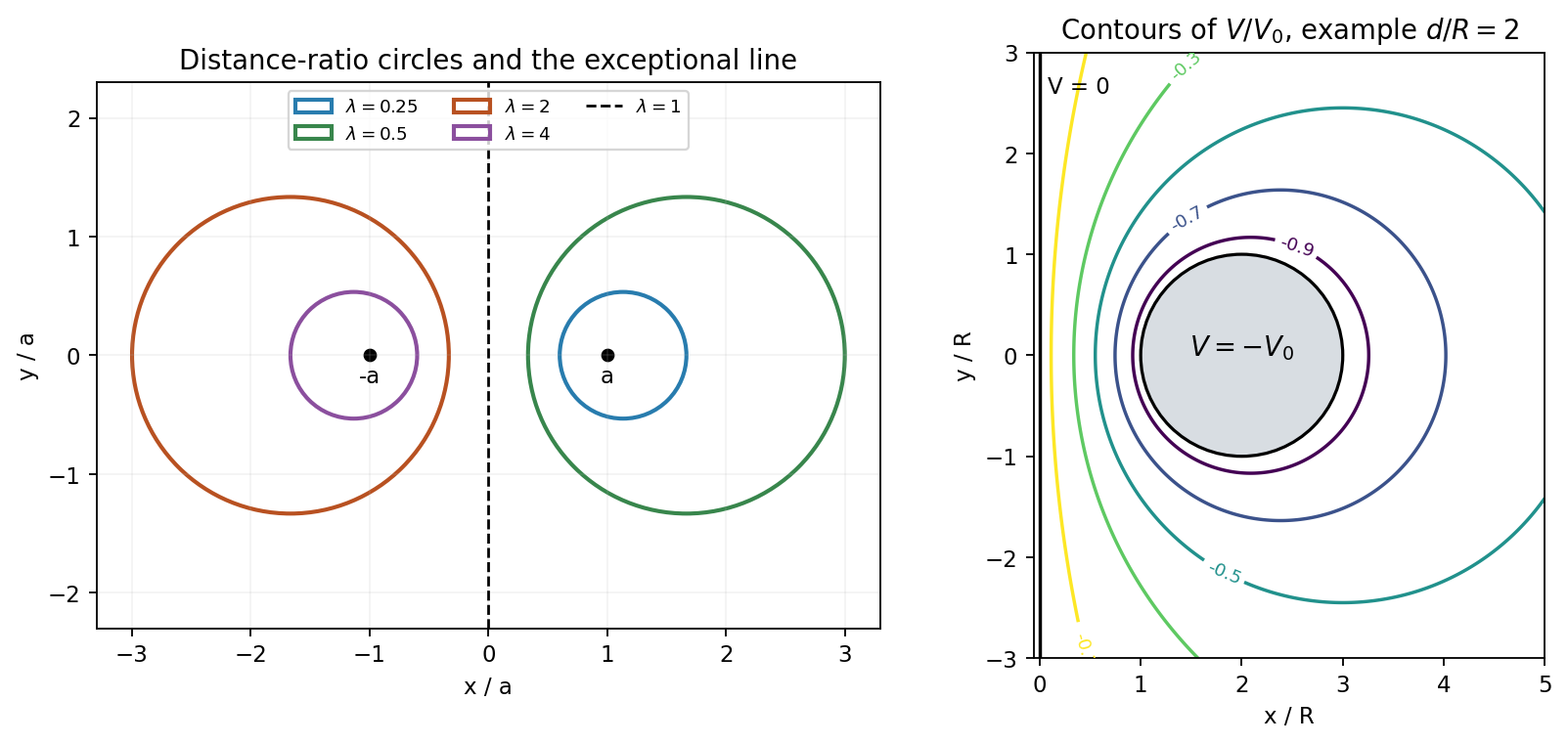
Codex 0 2026-10-18For a circle in the right half-plane use . Its centre and radius from part (ii) satisfy . Hence choosePut . Then andIndeed the Apollonius circle has centre and radius . Its logarithmic modulus is therefore , while on the modulus is one. The logarithmic Dirichlet potential between a circle and a line isThe logarithmic singularity at lies inside the excluded disk, since . The other singularity, at , lies outside the right half-plane. Thus the real logarithmic modulus is harmonic throughout the required region and has exactly the two specified boundary values.
Local branches of the complex logarithm justify harmonicity; its real part is globally single-valued even though the complex logarithm need not be single-valued around the excluded disk. The displayed solution is bounded and tends to zero at infinity. A boundedness or corresponding far-field condition supplies uniqueness in this unbounded domain; finite boundary values alone do not rule out unbounded additional harmonic solutions. The same geometry appears in cylinder-plane image charges.

New to topics? Read the docs here!