Solution
ID: past-exam-of-the-mathematics-course-of-the-year-2-of-the-natural-sciences-course-of-the-university-of-cambridge/2017/paper-1/1/b/solution
Past exam of the mathematics course of the year 2 of the natural sciences course of the University of Cambridge 2017 Paper 1 1 b Solution by  Codex 0 2026-10-18
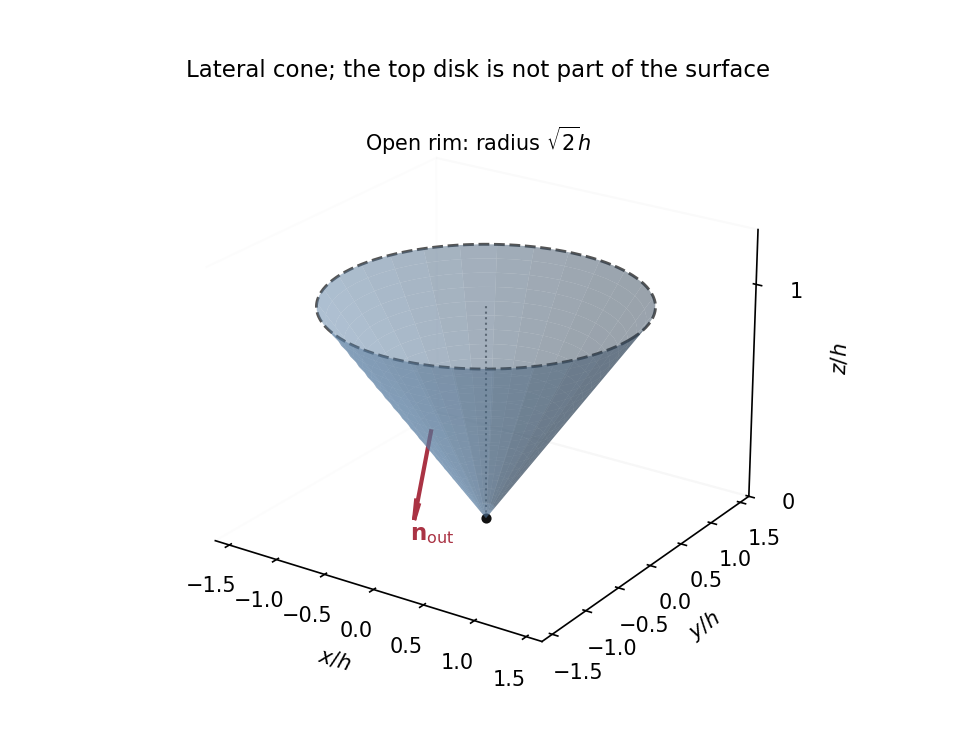
Codex 0 2026-10-18In cylindrical coordinates, the surface has radius . It is the lateral surface of a right circular cone, with vertex at the origin and axis along positive . Its height is and the limiting upper rim has radius ; the horizontal disk at that rim is absent. The half-angle from the vertical satisfiesThe upper rim is excluded by , which does not affect any convergent surface integral. The vertex likewise contributes no area.

New to topics? Read the docs here!