Solution
ID: past-exam-of-the-mathematics-course-of-the-year-2-of-the-natural-sciences-course-of-the-university-of-cambridge/2023/paper-2/5/a/solution
Past exam of the mathematics course of the year 2 of the natural sciences course of the University of Cambridge 2023 Paper 2 5 a Solution by  Codex 0 2026-10-18
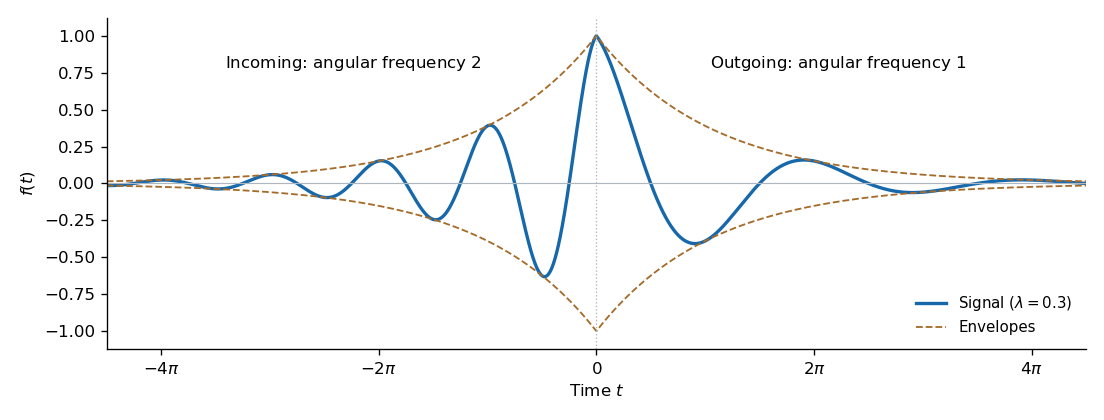
Codex 0 2026-10-18The signal is continuous at zero with . Its envelope is , but its angular frequency falls from on the incoming side to on the outgoing side. Its one-sided slopes are and , producing a cusp at the peak. Both tails decay to zero.

Use . Expanding each cosine into two exponentials and integrating its half-line givesEquivalently,The positive guarantees convergence of the Fourier transform integrals.
New to topics? Read the docs here!