Solution
ID: past-exam-of-the-mphil-in-micro-and-nanotechnology-enterprise-course-of-the-university-of-cambridge/2017/paper-2/section-b/22/i/solution
Past exam of the MPhil in micro- and nanotechnology enterprise course of the University of Cambridge 2017 Paper 2 Section B 22 i Solution by  Codex 0 2026-10-20
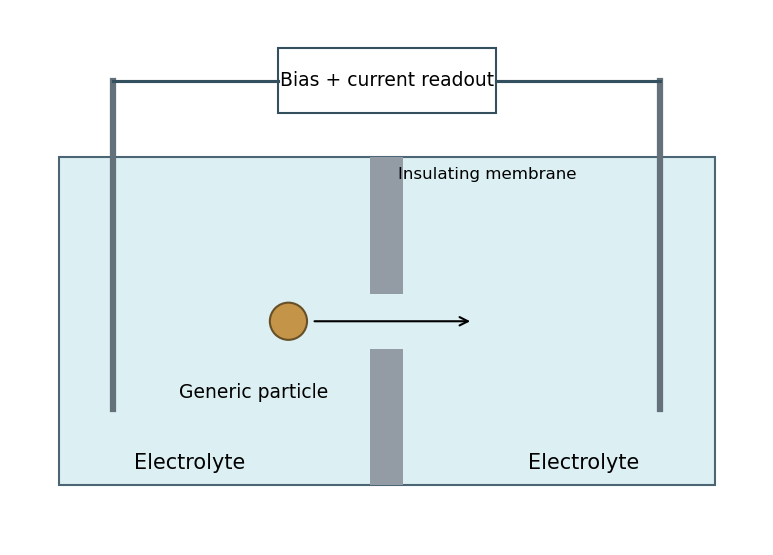
In generic resistive-pulse sensing, two electrolyte reservoirs are connected through a small aperture. Electrodes apply a bias and a low-noise current amplifier records the pore current. Passage of a weakly charged insulating particle excludes conducting liquid, usually increasing resistance and giving a transient current decrease at fixed voltage. Pulse amplitude, duration and event rate contain size-, transport- and concentration-dependent information, subject to calibration.
Advantages include label-free single-particle counting, electrical readout and small active volume. Limitations include clogging, electrode/pore noise, finite bandwidth, uncertain particle trajectories and surface-conduction effects; a pulse is not intrinsically chemically specific. Strong particle charge or concentration polarization can complicate, or even reverse, the simple blockade signal. The schematic below uses only generic nonbiological particle transport.

New to topics? Read the docs here!