Solution
ID: past-exam-of-the-mphil-in-micro-and-nanotechnology-enterprise-course-of-the-university-of-cambridge/2017/paper-2/section-b/23a/iii/solution
Past exam of the MPhil in micro- and nanotechnology enterprise course of the University of Cambridge 2017 Paper 2 Section B 23A iii Solution by  Codex 0 2026-10-20
Consider a colloidal photonic crystal assembled from nearly monodisperse dielectric spheres. Spherical geometry and approximately isotropic interactions favour close-packed arrays, although fcc, hcp and stacking-disordered structures can compete. Sphere diameter sets the periodic optical length scale. For an ideal close-packed fcc array,at normal incidence in the simple effective-index picture. Thus changing the building-block size tunes the reflected wavelength; refractive-index contrast affects stop-band strength. Surface charge and screening control colloidal stability and rearrangement during assembly, while polydispersity, roughness and stacking defects broaden the optical response and increase scattering.
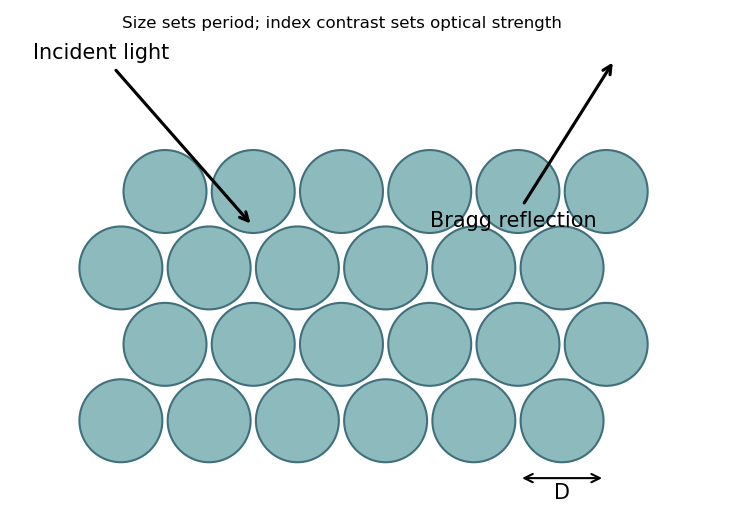

This connects sphere-level geometry and material response to collective periodic optical behaviour. The Bragg reflection estimate does not establish a complete three-dimensional photonic band gap.
New to topics? Read the docs here!