Solution
ID: past-exam-of-the-mphil-in-micro-and-nanotechnology-enterprise-course-of-the-university-of-cambridge/2018/paper-1/section-a-ii/3/i/solution
Past exam of the MPhil in micro- and nanotechnology enterprise course of the University of Cambridge 2018 Paper 1 Section A(ii) 3 i Solution by  Codex 0 2026-10-20
Treat the specified particles only as rigid geometric shadowing objects; no biological preparation or interpretation is needed. Their projected shapes are rounded-ended rods with straight central length and cap radius . Normal, collimated evaporation deposits metal in the gaps between projected particle footprints, leaving isolated small islands after mask removal, rather than a metal replica of each rod.
One concrete dense parallel packing has center translationsAdjacent rounded ends then touch at triangular arrangements. The open regions are small curvilinear triangular gaps near those ends. This is a specified geometrical packing for the sketch; the words close-packed do not uniquely prescribe the domain orientation or registry of all real sheets.
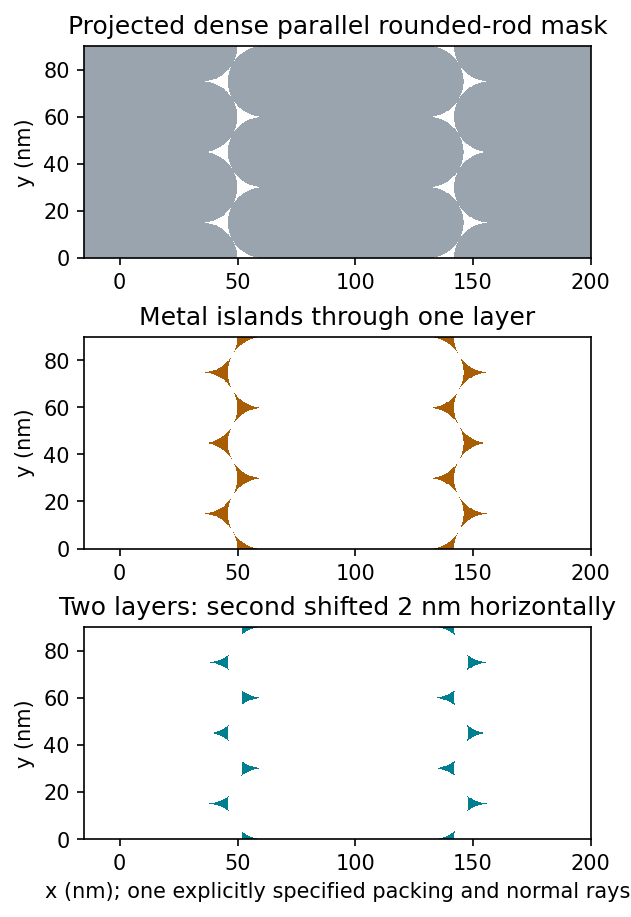
Original geometric calculation of rounded-rod shadow masks, deposited islands and the effect of shifting a second layer; no source illustration is reproduced
. Details. 
Particle size and shape distributions change the gap size and spacing. Misorientation, missing particles, boundaries between ordered domains, overlaps, incomplete coverage and drying-induced cracks interrupt long-range order. Substrate roughness and uneven adhesion distort the arrangement. A finite source angle produces deposition shadowing and penumbra; surface diffusion, island nucleation and increasing film thickness can broaden or merge deposited regions. These are generic geometry and materials effects, not assumptions about a biological assembly mechanism.
New to topics? Read the docs here!