Solution
ID: past-exam-of-the-mphil-in-micro-and-nanotechnology-enterprise-course-of-the-university-of-cambridge/2019/paper-2/section-a-iii/19/ii/solution
Past exam of the MPhil in micro- and nanotechnology enterprise course of the University of Cambridge 2019 Paper 2 Section A(iii) 19 ii Solution by  Codex 0 2026-10-20
For a triangular resistance network with edge resistances , replacing it by a star gives the arm at each terminal as the product of its two adjacent triangle resistances divided by . This Delta-star transformation preserves the pressure-flow relation at all three terminals, just as in a linear electrical network.
Apply it recursively to the two-rail ladder. Represent the first grooves by a three-terminal star with arms leading respectively to the fixed inlet, frontier of the left rail and frontier of the right rail. Grooves are added from inlet toward outlet. Adding the next pair of rail segments gives and ; the new groove closes a triangle between the old star centre and the two new rail endpoints. Convert that triangle to a star and combine its centre arm in series with .
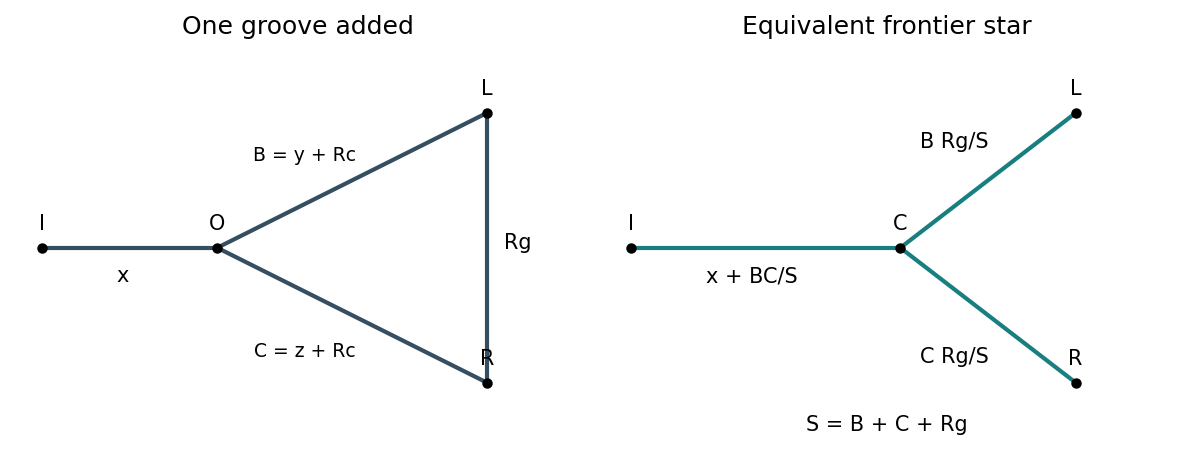

This method retains unequal pressure drops and unequal flow division along the rails; their finite resistances cannot be ignored when assigning the groove flows.
New to topics? Read the docs here!