Solution
ID: past-exam-of-the-mphil-in-micro-and-nanotechnology-enterprise-course-of-the-university-of-cambridge/2019/paper-2/section-b/21/iii/solution
Past exam of the MPhil in micro- and nanotechnology enterprise course of the University of Cambridge 2019 Paper 2 Section B 21 iii Solution by  Codex 0 2026-10-20
A larger-gap AlGaAs barrier has a higher conduction-band edge than GaAs. Donors in AlGaAs supply electrons that transfer into lower-energy GaAs states, leaving a positively charged donor region. The resulting electrostatic field bends the GaAs conduction band into a triangular interface well. Motion normal to the interface is quantized, while motion parallel to it remains approximately free, producing a two-dimensional electron gas.
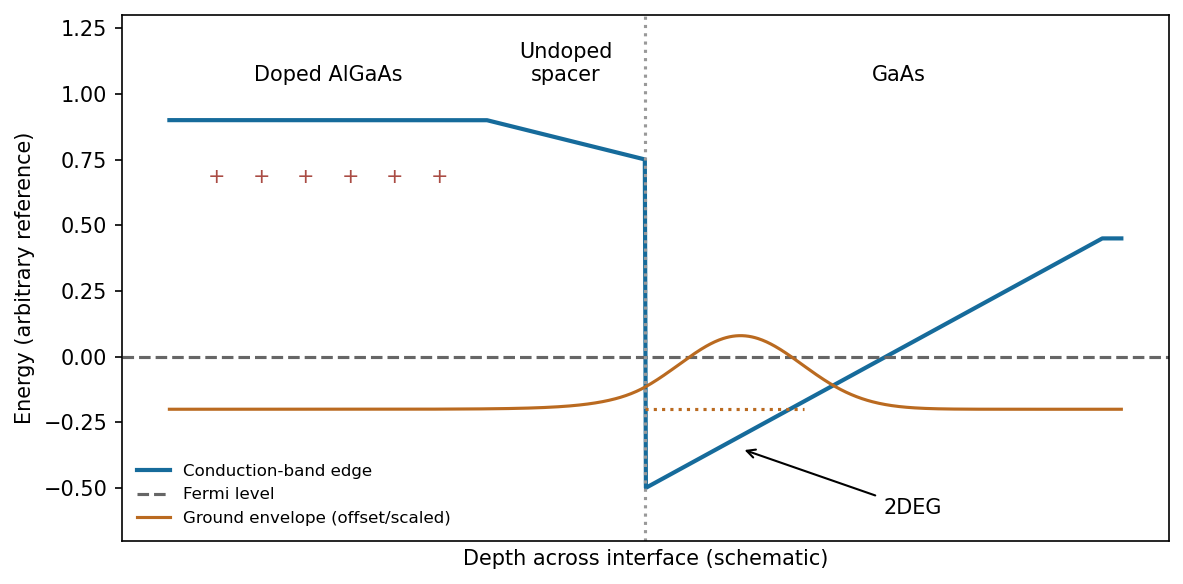
An illustrative remotely doped heterojunction separates the electron envelope from ionized donors
. Source. Details. 
The confined envelope peaks just inside GaAs and decays into the AlGaAs barrier; a triangular-well treatment gives an Airy-function-like envelope with boundary matching. An undoped spacer separates the electrons from the donors, strongly reducing ionized-impurity scattering compared with uniformly doped 3D material and enabling high mobility. Band offsets, donor supply, interface roughness and electrostatics jointly determine whether a single occupied subband is obtained.
New to topics? Read the docs here!