Solution
ID: past-exam-of-the-mphil-in-micro-and-nanotechnology-enterprise-course-of-the-university-of-cambridge/2022/paper-2/section-b/23/ii/solution
Past exam of the MPhil in micro- and nanotechnology enterprise course of the University of Cambridge 2022 Paper 2 Section B 23 ii Solution by  Codex 0 2026-10-20
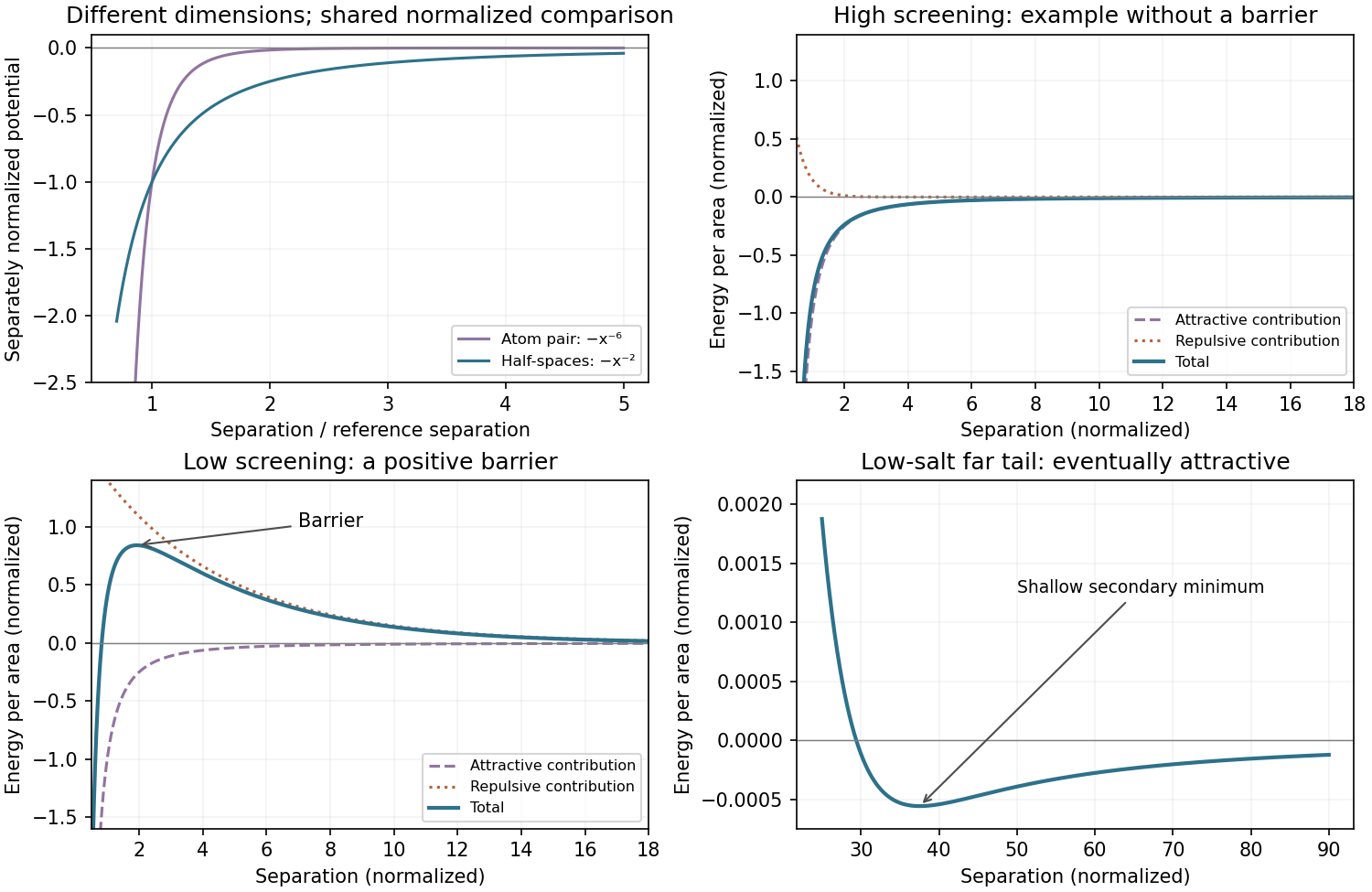
The microscopic pair potential falls as , whereas integrating over two half-spaces gives an interaction energy per area . The plate attraction therefore decays much more slowly with distance because many pairs contribute. The quantities have different dimensions, so the shared sketch uses separately normalized energies at a reference separation rather than pretending that joules and joules per square metre are directly comparable.
The attractive pressure isAt and the supplied effective ,The minus sign denotes decreasing separation. A total force cannot be calculated without the interacting area: for area in square metres, . This uses the supplied nonretarded half-space model; finite film thickness, geometry and retardation at larger distances can change it.

New to topics? Read the docs here!