Solution
ID: past-exam-of-the-mphil-in-micro-and-nanotechnology-enterprise-course-of-the-university-of-cambridge/2023/paper-1/section-a-iii/7/i/solution
Past exam of the MPhil in micro- and nanotechnology enterprise course of the University of Cambridge 2023 Paper 1 Section A(iii) 7 i Solution by  Codex 0 2026-10-20
At fixed discharge current, delivered voltage can be represented aswhere is discharged charge and the terms denote distinct physical losses. A typical trace has an initial drop from open circuit, an approximately flat useful region and a final decline toward cutoff. Its exact shape depends on the cell chemistry and current; not every battery has an equally flat plateau.
Four distinguishable contributions are:
- Ohmic polarization: electronic, ionic and contact resistance cause a rapid drop on applying current. This need not wait for a concentration gradient to develop.
- Activation overpotential: finite electrode-reaction kinetics require a departure from equilibrium to sustain charge transfer. It is important when the exchange current is small.
- Concentration overpotential: electrolyte transport and diffusion within active particles can deplete reactants or accumulate products near reaction sites. These losses often grow near the end of discharge or at high current.
- Phase-transformation polarization: nucleation and growth of a new phase can require extra driving force, produce an initial voltage dip or cause hysteresis. It is especially relevant to conversion and two-phase electrodes, rather than a universal independent loss in every chemistry.
Terminology sometimes groups solid-state transport or phase-change effects differently. The important distinction is the mechanism, not counting the same diffusion loss under two names. A falling equilibrium voltage as composition changes is also not, by itself, polarization.
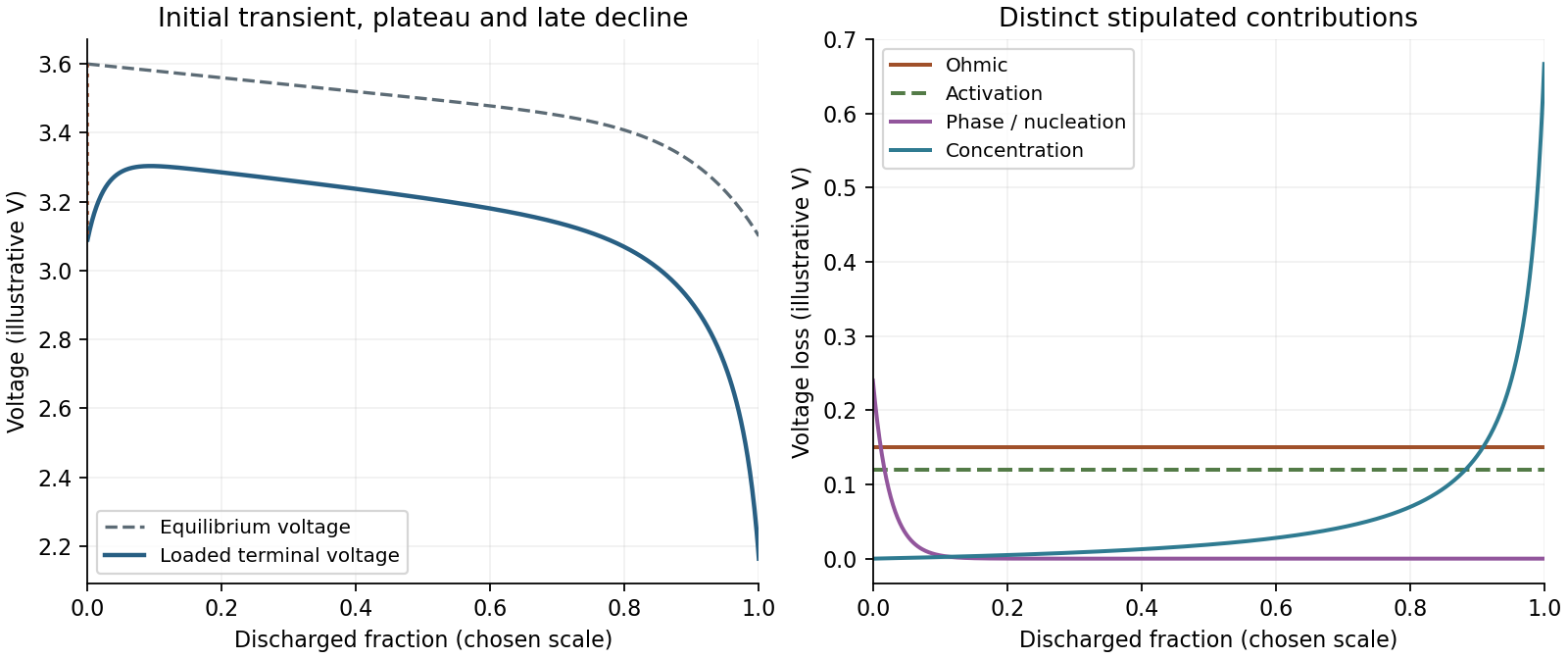
An illustrative discharge voltage combines equilibrium changes and distinct losses
. Original stipulated model, not battery measurements. The loss components show an instantaneous resistive contribution, activation loss, a transient nucleation-related contribution and increasing late-discharge transport loss. The equilibrium curve is plotted separately. Details.
New to topics? Read the docs here!