Solution
ID: past-exam-of-the-mphil-in-micro-and-nanotechnology-enterprise-course-of-the-university-of-cambridge/2023/paper-1/section-b/10/ii/a/solution
Past exam of the MPhil in micro- and nanotechnology enterprise course of the University of Cambridge 2023 Paper 1 Section B 10 ii a Solution by  Codex 0 2026-10-20
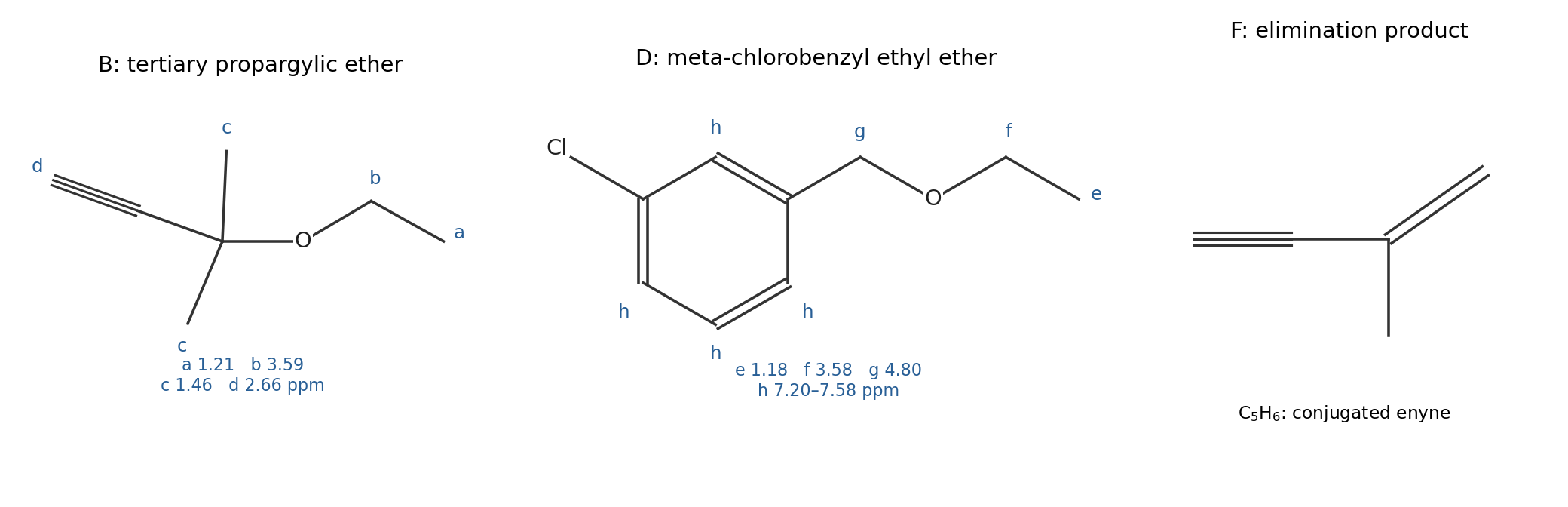
The products areB retains the terminal alkyne and replaces the tertiary propargylic chlorine with ethoxy. D replaces the benzylic chlorine while retaining the aromatic chlorine; its meta arrangement follows from the drawn starting material, rather than from four aromatic protons alone.
| Product | Proton shift / ppm | Assignment |
|---|---|---|
| B | 1.21, 3H triplet | Ethoxy terminal methyl, coupled to the adjacent two protons. |
| B | 1.46, 6H singlet | Two equivalent methyl groups on the substituted carbon, with no neighboring proton to split them. |
| B | 2.66, 1H singlet | Terminal alkyne proton. |
| B | 3.59, 2H quartet | Ethoxy methylene next to oxygen, coupled to its methyl group. |
| D | 1.18, 3H triplet; 3.58, 2H quartet | The ethoxy group, with a common approximately 7 Hz coupling. |
| D | 4.80, 2H singlet | Benzylic methylene attached to oxygen, with no vicinal aliphatic proton. |
| D | Two aromatic multiplet regions, 4H total | The four remaining ring protons of the disubstituted aromatic ring. |
For B, the strong band is the terminal sp C–H stretch, the band is aliphatic C–H stretching, and the weak band is the alkyne stretch. The terminal proton and alkyne band together distinguish this from an alcohol interpretation of the high-frequency absorption.

New to topics? Read the docs here!