Solution
ID: past-exam-of-the-nonlinear-optics-and-quantum-states-of-light-course-of-the-university-of-cambridge/2016/paper-1/1/solution
Past exam of the nonlinear Optics and Quantum States of Light course of the University of Cambridge 2016 Paper 1 1 Solution by  Codex 0 2026-10-20
The process is sum-frequency generation, with . The same reversible three-wave mixing interaction permits the reverse conversion when the higher-frequency field supplies the pump. The second-order nonlinear polarization couples the three waves; its effective coefficient includes the crystal orientation and polarizations.
One efficiency limit is phase mismatch: contributions generated at different positions acquire different phases and can cancel. A second practical limit is spatial walk-off, which reduces the overlap of finite beams in a birefringent crystal. A beam radius and relative walk-off angle give an overlap length of order . Absorption and scattering provide further losses. Group-velocity mismatch matters for pulses, and pump depletion eventually invalidates an undepleted-pump calculation; none of these effects should be silently included in the ideal lossless plane-wave equations.
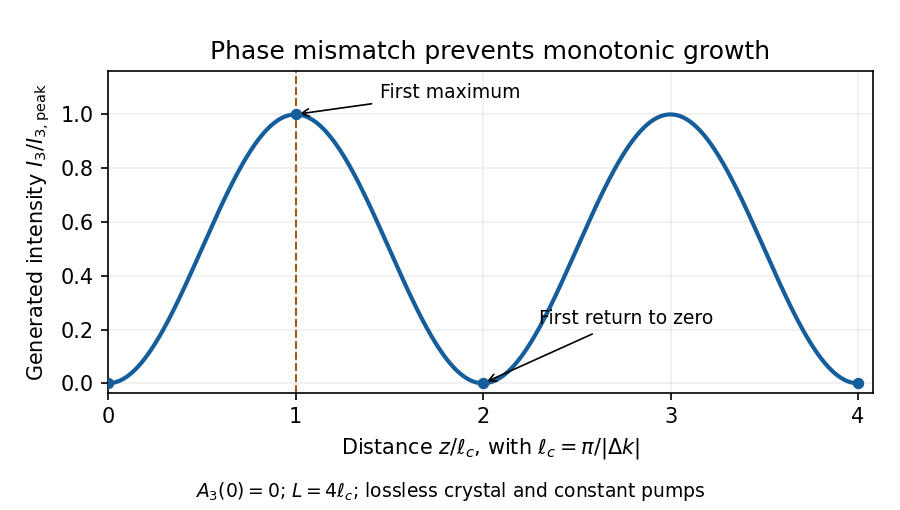
Define and hold constant. Direct integration of the driven equation giveswhere . The second expression has a continuous phase-matched limit. If the generated field is initially absent,For this is proportional to : the first maximum is at the nonlinear optical coherence length , and the first subsequent zero is at . A seed adds interference with the generated amplitude and can change that pattern. At exact phase matching, the unseeded result grows as only while pump depletion remains negligible.

To retain depletion consistently, differentiate each intensity before inserting the coupled equations:For real in the lossless convention, put . The result isThe signs follow the printed amplitude equations. In initial up-conversion, the newly generated makes , so the two input intensities decrease while the sum-frequency intensity increases. Adding the derivatives gives zero because . The total intensity is conserved, even though the three individual intensities change.
The Manley-Rowe relations areDividing an intensity by gives photon flux density. A conversion event removes one photon from each lower-frequency mode and adds one to the upper mode, or does the reverse. Therefore and count conserved sums of photon fluxes, while counts the conserved lower-frequency difference. They are not three independent invariants: . Energy conservation is also recovered as .
The unweighted combinations generally fail because the exchanged photons have different energies. Explicitly,The qualification “generally” matters: is conserved for equal lower frequencies in a distinct-mode degenerate case, and every derivative vanishes when there is no exchange. The equations establish nonconservation for generic unequal-frequency interaction, not for all special solutions.
New to topics? Read the docs here!