Solution
ID: past-exam-of-the-nuclear-and-particle-physics-course-of-the-university-of-oxford/2022/2/f/i/solution
Past exam of the nuclear and particle physics course of the University of Oxford 2022 2 f i Solution by  Codex 0 2026-10-25
There is a -channel Z boson contribution and a crossed, -channel W boson contribution. The latter pairs the incoming electron neutrino with the outgoing electron, and the incoming electron with the outgoing electron neutrino. Both contribute coherently to the same elastic final state.
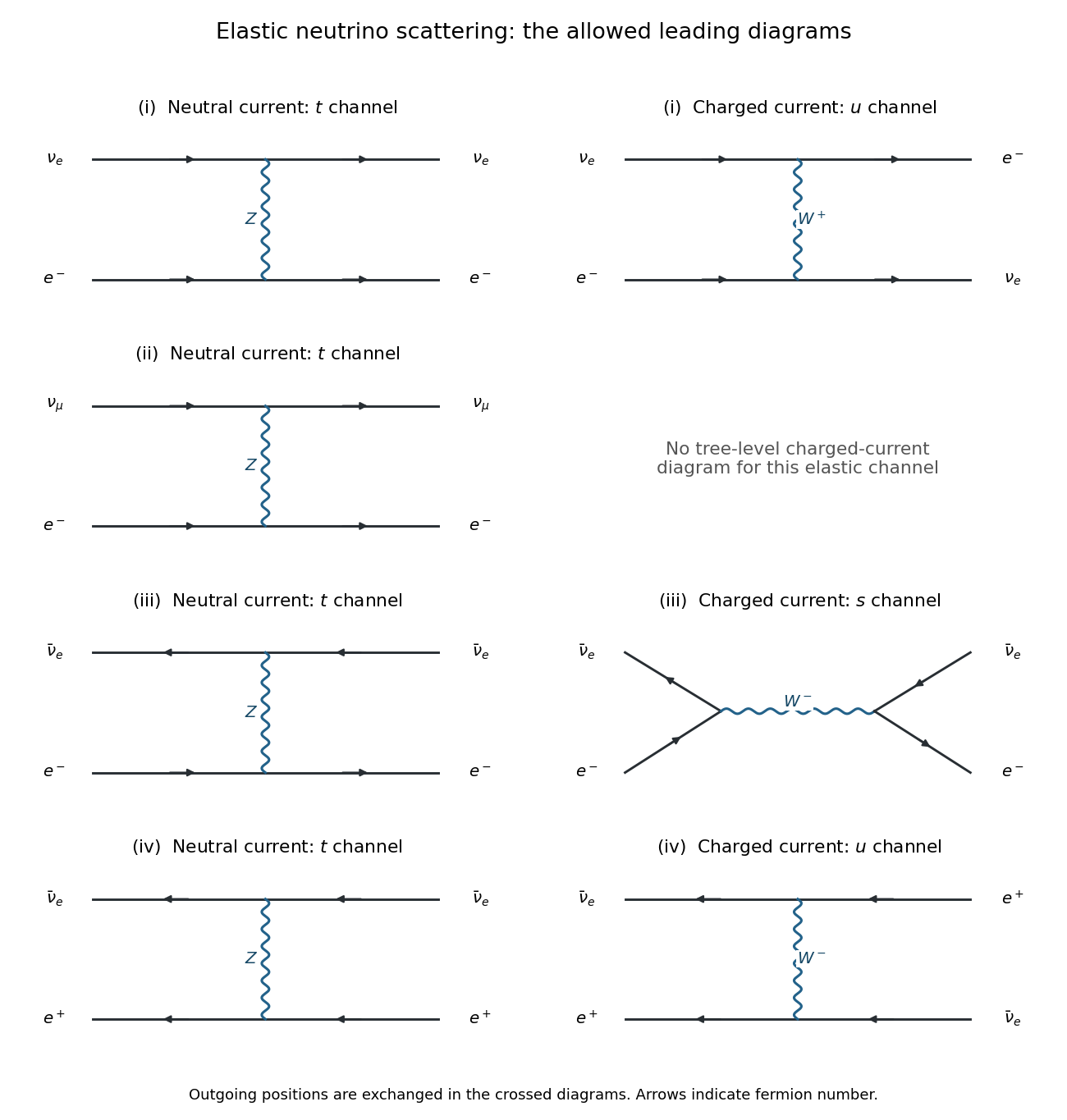

For a concrete comparison, take unpolarized targets, the same Mandelstam invariant in all four reactions, and . In a stationary-electron experiment this includes with . Define , using the weak mixing angle, and . The weak neutral current has chiral couplings , ; the weak charged current shifts by one. ConsequentlyThe factor comes from integrating the opposite-chirality angular weight: in the massless limit . Thus the relative rate depends on the chiral couplings and their interference, rather than simply on the number of diagrams.
New to topics? Read the docs here!