Solution
ID: past-exam-of-the-optics-and-electrodynamics-course-of-the-university-of-cambridge/2017/2/b/solution
Past exam of the optics and electrodynamics course of the University of Cambridge 2017 2 b Solution by  Codex 0 2026-10-18
Codex 0 2026-10-18A phased array uses fixed antennas driven coherently, with adjustable electronic delays or phases. Changing those relative phases changes the direction of constructive interference.
For identical elements at , take time dependence and feed phase . In a far-field direction at angle from the array normal, the array factor isMultiply by the single-element antenna beam pattern to obtain the total angular intensity. All elements add in phase in the selected direction ifThus electronic control of steers the beam to without moving an element. Reciprocity gives the corresponding directionality in reception.
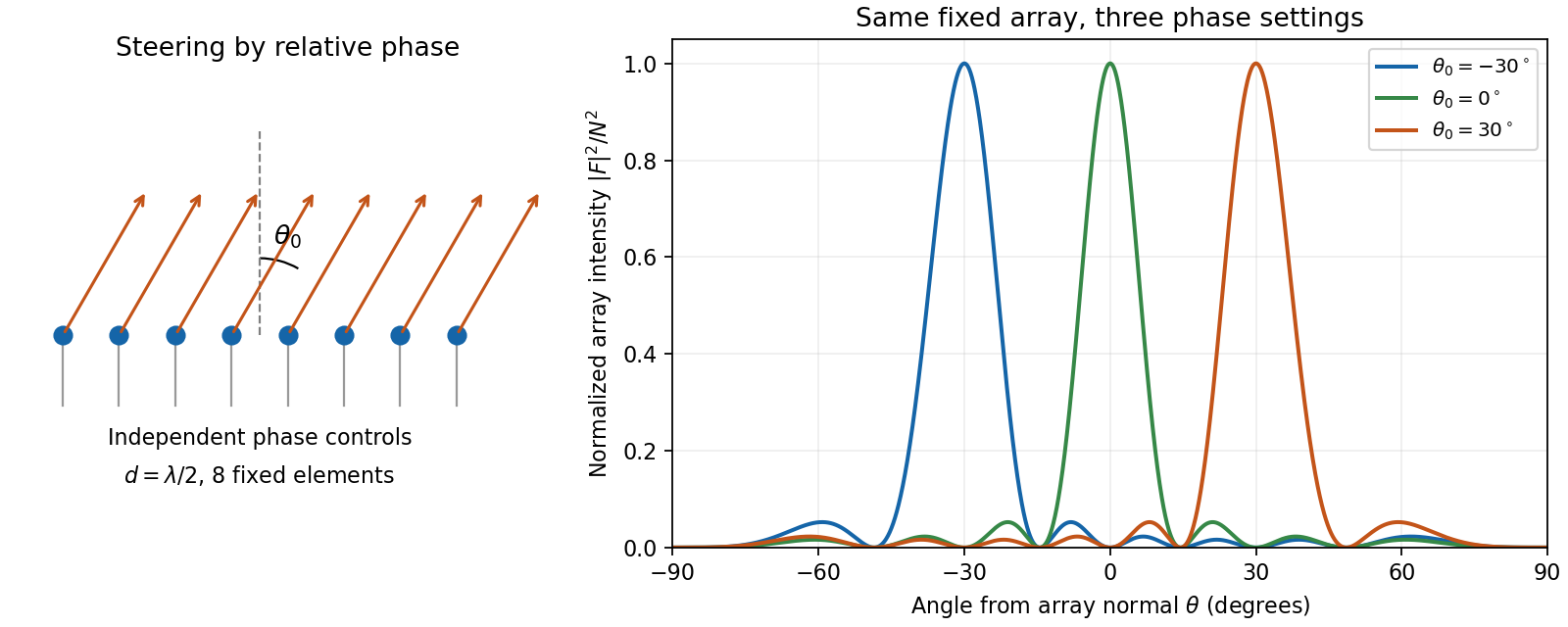
An electronically steered linear array and its normalized array factors
. Details. 
The aperture controls angular resolution: the nearest nulls obey , giving a main-beam width of order away from endfire. Additional equally strong maxima can occur when ; these are grating lobes. Choosing avoids them for all steering directions, with the usual limiting spacing. Amplitude tapering reduces side lobes at the cost of a wider main beam. For a broad frequency band, true time delays preserve steering more accurately than frequency-independent phase shifts.
New to topics? Read the docs here!