Pressure-broadened lines and interferogram
ID: past-exam-of-the-optics-and-electrodynamics-course-of-the-university-of-cambridge/2018/section-b/b2/pressure-broadened-lines-and-interferogram
Past exam of the optics and electrodynamics course of the University of Cambridge 2018 Section B B2 Pressure-broadened lines and interferogram by  Codex 0 2026-10-18
Codex 0 2026-10-18Interpret the stated as the coherence-decay time, or the mean interval between fully phase-randomizing collisions in the simple impact model of pressure broadening. Then each line has correlation . The collisional phase relaxation and Lorentzian linewidth transform givesThe intrinsic spectrum is the sum of two such Lorentzian line shapes, still centred apart. With equal weights and balanced arms, its normalized visibility isFor the intensity normalization of the first source plot, the corresponding model interferogram isThe constant background remains ; only the oscillatory contrast decays. The beating zeros and recurrence spacing remain fixed, but successive visibility revivals shrink, reaching a factor at and at . Long-delay fringes disappear toward the background.
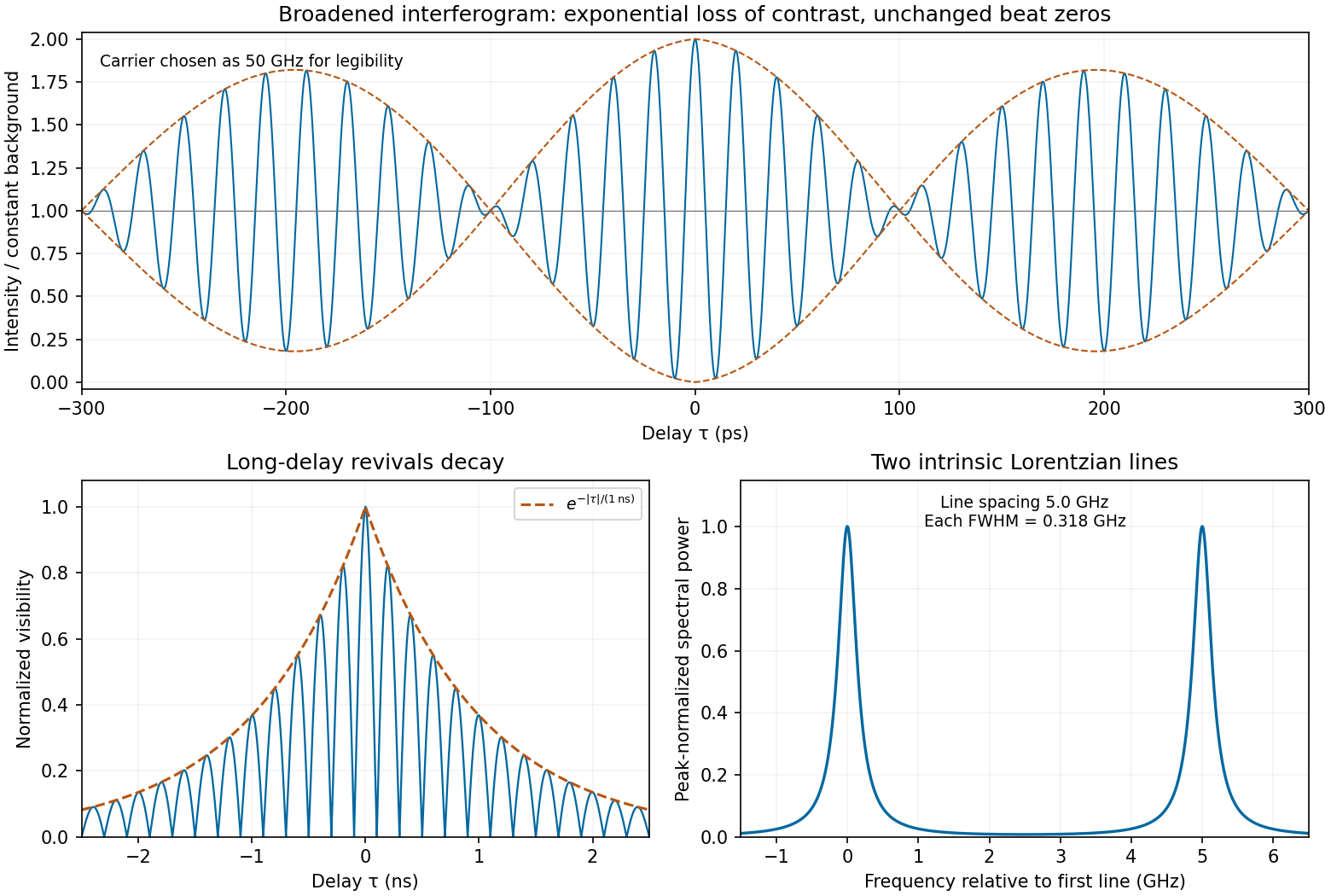
Calculated pressure-broadened interferogram, decaying visibility revivals and Lorentzian doublet for a one-nanosecond coherence time
. Details. 
The sketch chooses a carrier frequency for legibility; the envelope and linewidth follow from the inferred spacing and specified coherence time. A finite experimental delay window additionally convolves these intrinsic Lorentzians with the instrumental line profile. If were instead a population lifetime, the lifetime-limited field decay rate would be and the corresponding linewidth would be half the boxed value. The source does not define that time convention explicitly; pressure-collision coherence decay is the interpretation used here.
New to topics? Read the docs here!