Solution
ID: past-exam-of-the-physics-1-paper-of-the-university-of-oxford/2016/7/solution
Past exam of the physics 1 paper of the University of Oxford 2016 7 Solution by  Codex 0 2026-10-25
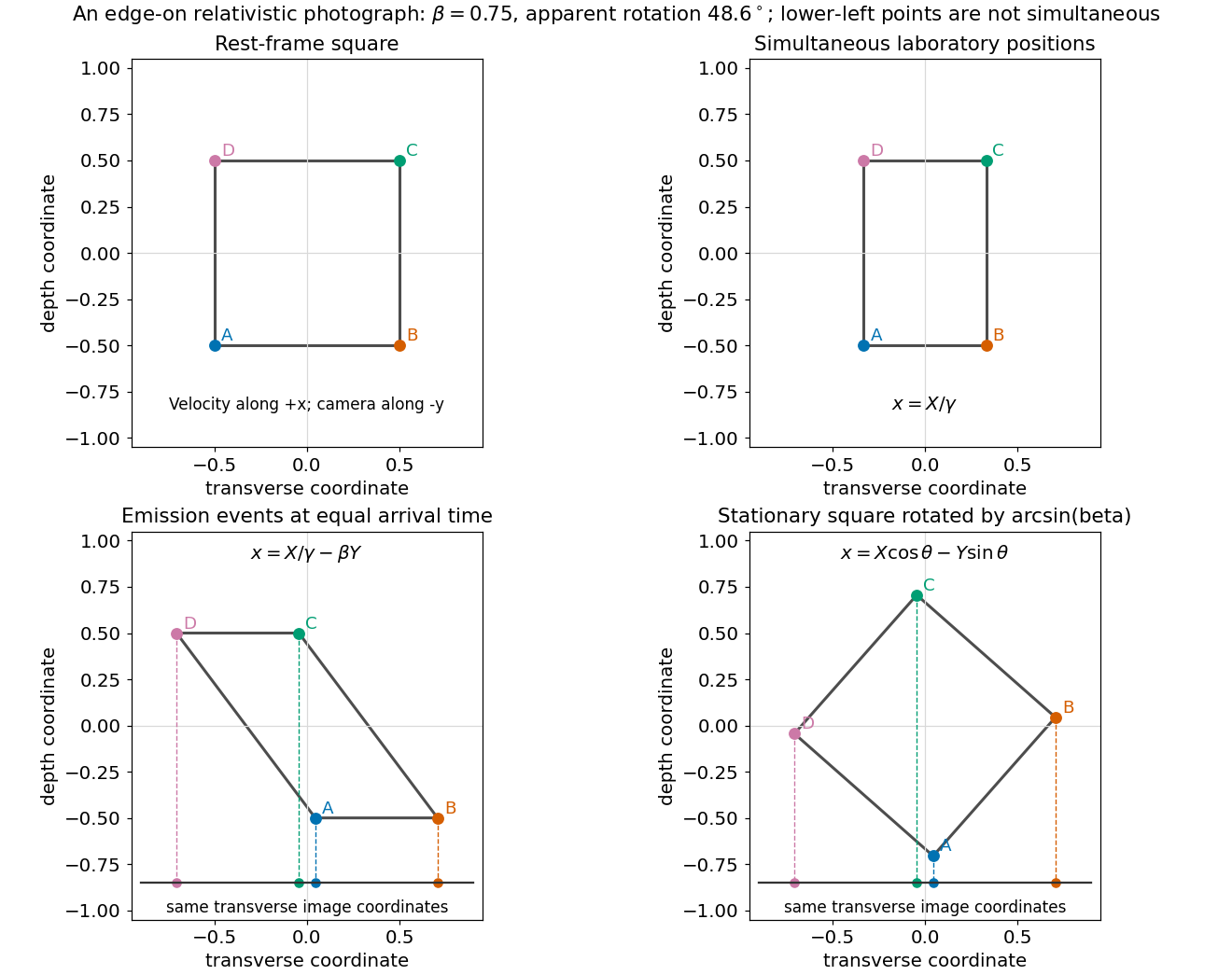
For a Lorentz boost along , the Lorentz transformation isTo calculate a photograph, compare photons that arrive together, which were generally emitted at different times. Put the lamina in the plane, moving along , and take the distant camera to lie along negative . Let be a material point's coordinates in the lamina's rest frame. At a laboratory time , its position satisfies , .
The distant-camera approximation makes the variable part of the light travel time . Equal arrival time therefore requires . Choose that constant to be zero. The point's photographed transverse coordinate becomesA stationary lamina rotated in its plane by would instead have the projected coordinate . The two projections agree whenThis is Terrell rotation. The shape defined by simultaneous laboratory positions still has length contraction; the photographic rotation comes from combining that contraction with unequal emission times. Reversing the viewing or motion direction reverses the apparent rotation's sign.

New to topics? Read the docs here!