Solution
ID: past-exam-of-the-physics-2-paper-of-the-university-of-oxford/2016-resit/10/solution
Past exam of the physics 2 paper of the University of Oxford 2016 resit 10 Solution by  Codex 0 2026-10-25
Monochromatic light has one frequency, or a bandwidth sufficiently narrow for the intended measurement. A lamp can illuminate the experiment through a narrow spectral filter or monochromator, followed by a small source aperture at the focus of a collimating lens. The aperture supplies spatial coherence across the slits; the lens supplies approximately parallel incident wavefronts. Two independently illuminated incoherent slits would not provide a stationary fringe pattern.
In the Fraunhofer approximation, the optical path difference at observation angle is . For equal single-slit intensities , adding the two wave amplitudes givesThe thin-slit idealization suppresses the individual diffraction envelope. If additionally , then and . The far-field condition does not by itself impose this small observation angle.
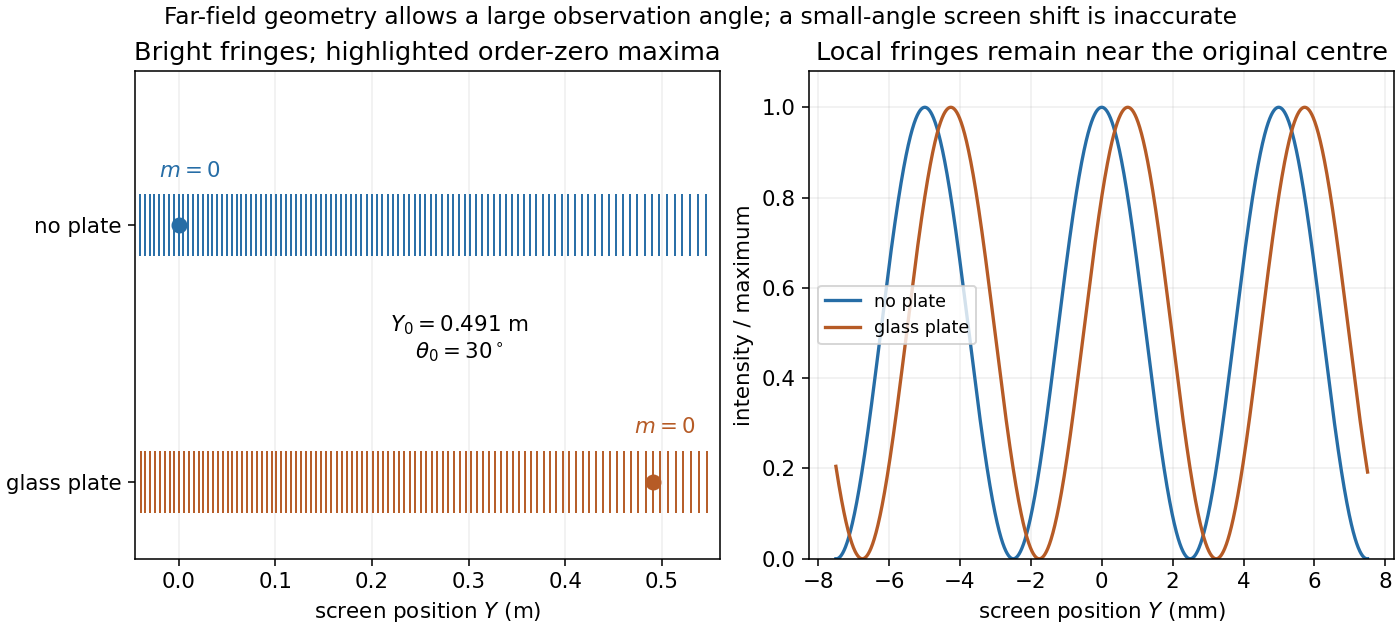
Let the upper slit contain the glass plate and take positive towards that slit. The extra optical path length is . Its total upper-minus-lower path difference is . The order-zero fringe therefore satisfiesIt moves towards the covered slit. Using here is a poor small-angle approximation: is not small. The order-zero fringe is being tracked as the optical delay is introduced; because the pattern is periodic in phase, many other bright fringes still lie near the original centre. Neglecting unequal glass transmission changes visibility but not the zero-path-difference condition.

New to topics? Read the docs here!