Solution
ID: past-exam-of-the-physics-2-paper-of-the-university-of-oxford/2016/9/d/solution
Past exam of the physics 2 paper of the University of Oxford 2016 9 d Solution by  Codex 0 2026-10-25
The largest field in each gap lies at that gap's smaller radius. Thus the quantity to minimize isFor positive , projecting any outside back to that interval reduces both absolute potential drops, so the optimum lies inside it. Within the interval, one candidate maximum decreases linearly with and the other increases linearly. Their maximum is minimized at their intersection, not by making the potential drops equal.
With , , and , the two maxima are and in . Equating them givesThe maximum is halved relative to the two-sphere system and is attained at both and . At and the optimized field is only about ; at the charged middle shell produces a jump.
For plotting, the two-sphere electric potential is . In the three-sphere system it isThe electric potential remains continuous at , while its radial derivative changes there. The graphs show both the continuous potentials and the one-sided gap fields; the marked endpoints identify all maxima.
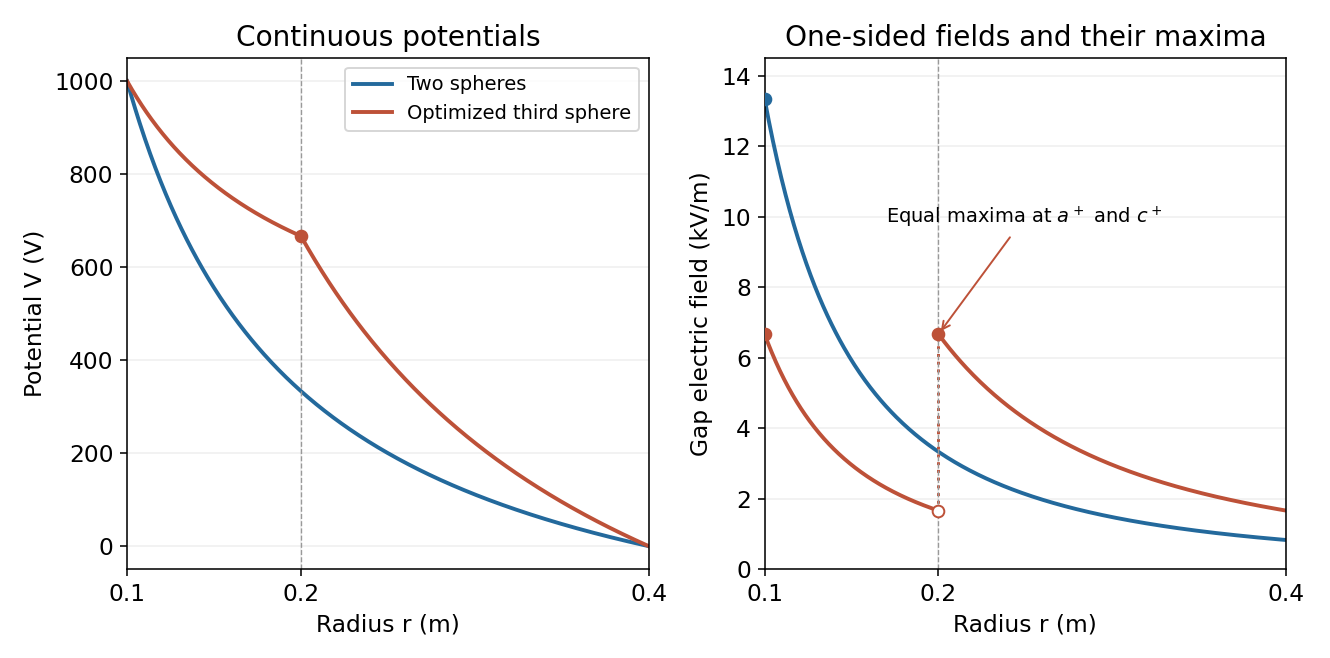
Potential and electric field before and after optimized intermediate-sphere bias
. Details. 
New to topics? Read the docs here!