Solution
ID: past-exam-of-the-physics-2-paper-of-the-university-of-oxford/2021-resit/7/e/solution
Past exam of the physics 2 paper of the University of Oxford 2021 resit 7 e Solution by  Codex 0 2026-10-25
The signal phase velocity in the coaxial cables is , so the guided wavelength is . The excess cable length is , adding a relative delay of and a relative wave phase of magnitudeLabel the two inputs so that the first configuration has total phase difference , where is the geometric phase difference. Swapping the unequal cables reverses that added wave phase, giving . For the same single-source received wave intensity in each arm,The two interference patterns are shifted by half a fringe: maxima in one are nulls in the other. At broadside both give , so swapping does not change the strength of every possible source. For small angles, the maximum-to-maximum shift is with the chosen baseline. Near broadside, the maxima of configuration A occur near and those of B near ; the signs are exchanged if the input labels are reversed. Independent satellites contribute separately according to these directional gains; their mutually uncorrelated signals should not be added as coherent amplitudes.
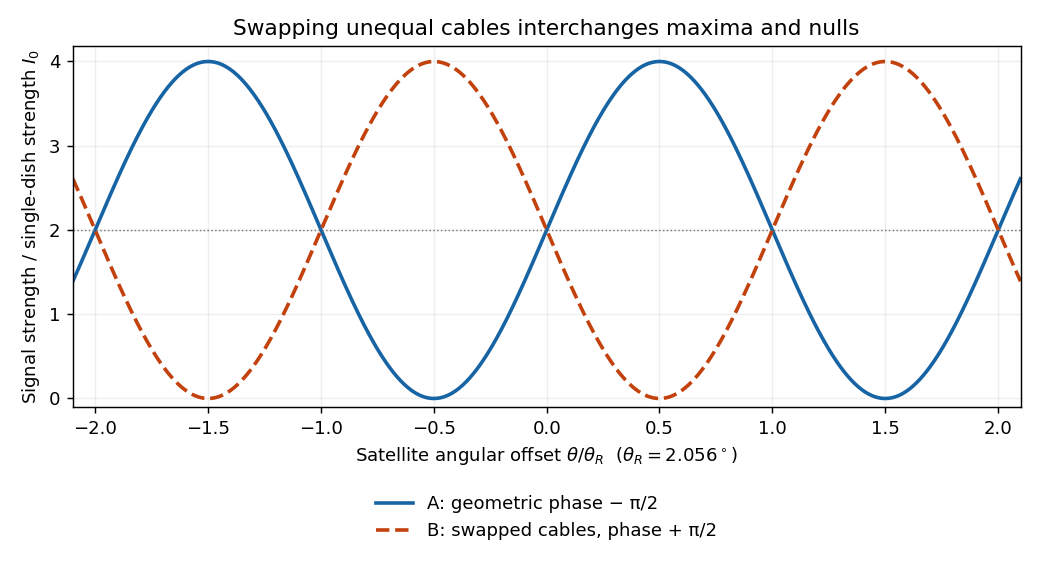
Calculated complementary two-dish signal strengths before and after swapping quarter-wavelength-delay cables
. Details. 
New to topics? Read the docs here!