Solution
ID: past-exam-of-the-physics-a-course-of-the-university-of-cambridge/2010/paper-1/section-b/b8/solution
Past exam of the physics A course of the University of Cambridge 2010 Paper 1 Section B B8 Solution by  Codex 0 2026-10-20
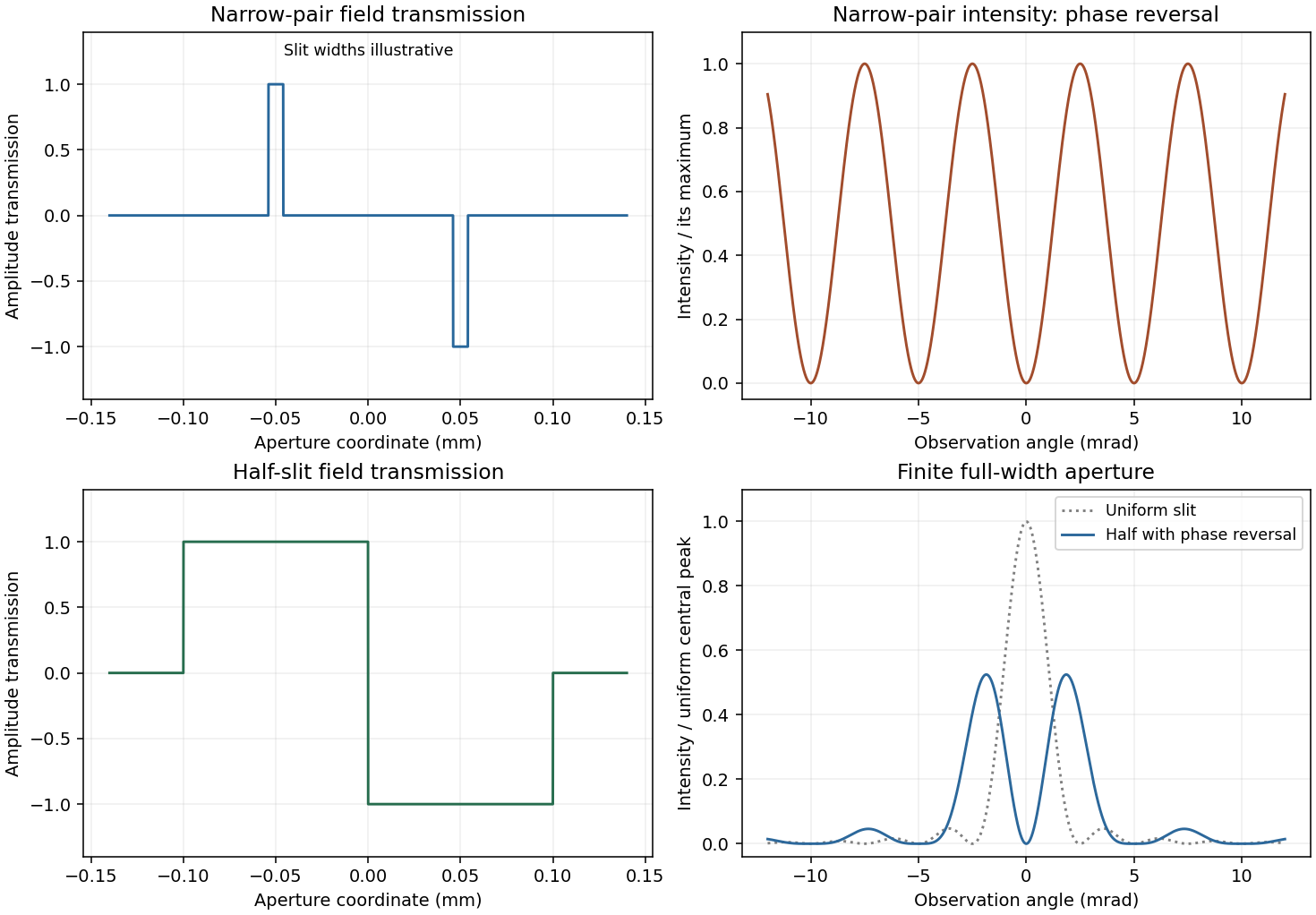
In Fraunhofer diffraction, the phase difference from aperture coordinate y to observation angle theta is , with . Coherent superposition of the transmitted field elements therefore givesThe common propagation factor is omitted. This is the Fourier transform of the complex amplitude transmission, not of its intensity.
For a uniform slit of total width , integration gives , where . Its normalized intensity is , with a central maximum and first zeros at .
For a half-covered slit choose on the left half and on the right. Put and . The two equal rectangles have centres separated by h, soThis half-slit phase-step diffraction factorization is the phase-reversed two-slit interference factor multiplied by the diffraction envelope of each half-slit. Here the half-slit width and centre separation both equal the earlier0.1mm separation. The central intensity is zero; the largest off-axis pair satisfies , giving . Other zeros are at . The plot includes the requested uniform-slit and half-covered patterns.

New to topics? Read the docs here!