Solution
ID: past-exam-of-the-physics-a-course-of-the-university-of-cambridge/2012/paper-2/section-a/4/solution
Past exam of the physics A course of the University of Cambridge 2012 Paper 2 Section A 4 Solution by  Codex 0 2026-10-20
At long wavelength, the acoustic phonon branch moves the two atoms in a cell nearly in phase: . In the limit this is rigid translation and . The optical phonon branch moves them oppositely, with stationary cell centre of mass: . Its frequency is finite because adjacent unlike atoms change their separation. For unequal masses the lighter atom has the larger optical displacement. Three-dimensional crystals have three acoustic branches and, with two atoms per primitive cell, three optical branches; longitudinal and transverse directions describe displacement relative to the wavevector. The name optical does not mean that every optical phonon branch is infrared-active: coupling also depends on effective charges and symmetry.
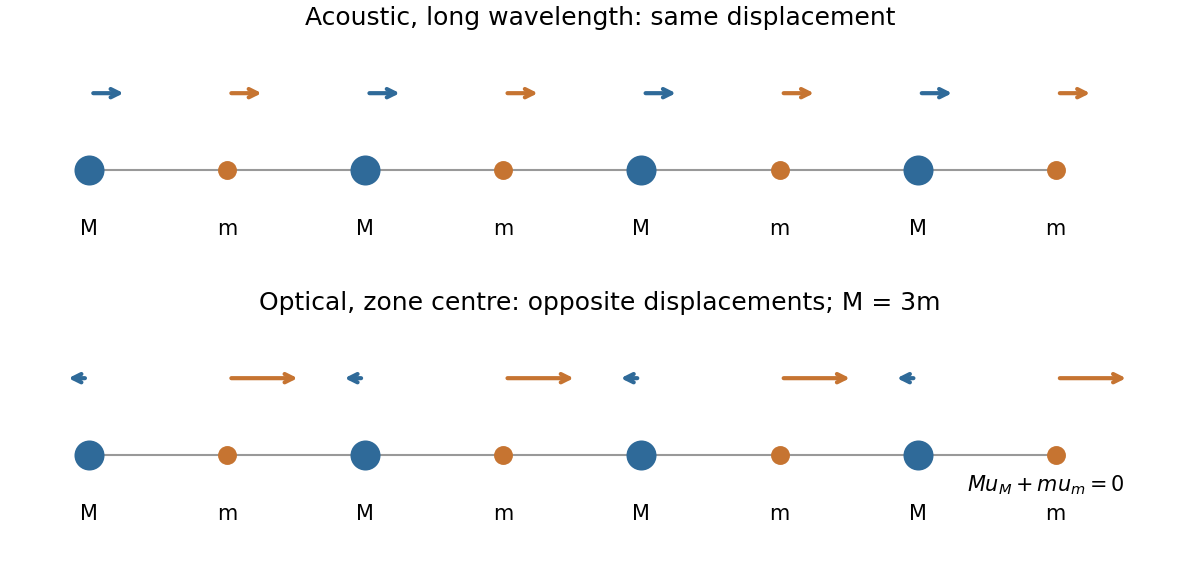
Original long-wavelength acoustic and optical displacement sketches for unequal masses, with optical centre-of-mass cancellation
. Details. 
New to topics? Read the docs here!