Solution
ID: past-exam-of-the-physics-course-of-the-year-1-of-the-natural-sciences-course-of-the-university-of-cambridge/2011/paper-1/section-b/b7/solution
Past exam of the physics course of the year 1 of the natural sciences course of the University of Cambridge 2011 Paper 1 Section B B7 Solution by  Codex 0 2026-10-20
For a steady uniform jet, the mass flow rate is . The transported momentum flux and kinetic energy flux of a uniform jet areIncompressibility gives piston speed . Equating piston power to the jet's kinetic power givesThis ideal result neglects losses and the kinetic energy of fluid moving slowly inside the large cylinder. Retaining an inlet speed correction would multiply the pressure expression by .
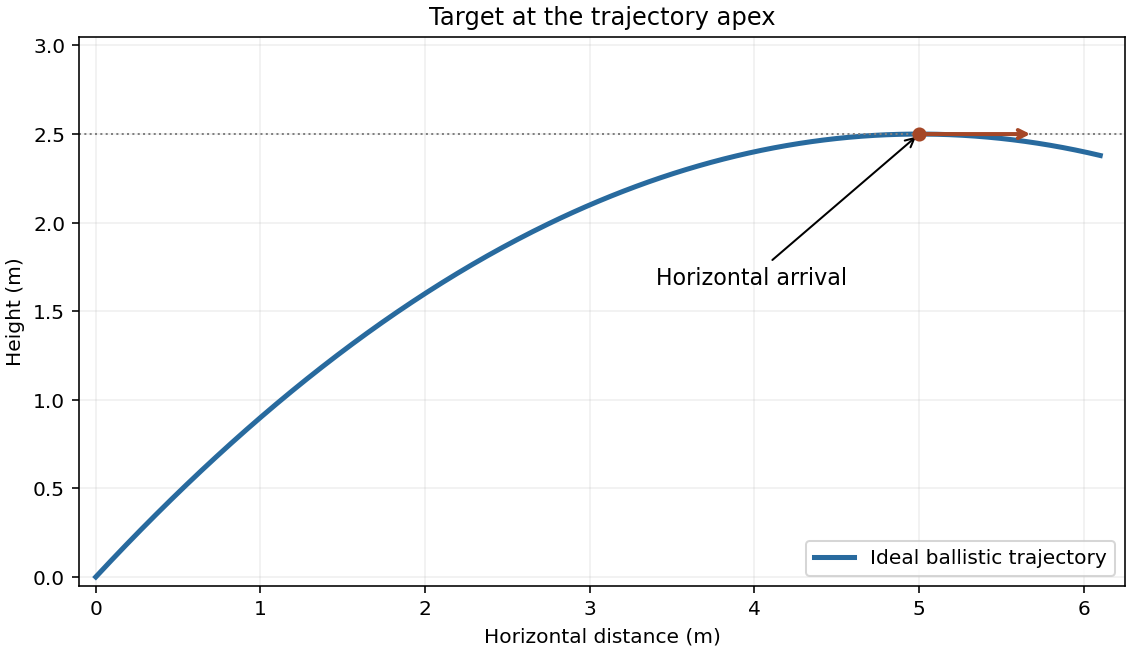
A horizontal impact occurs at the projectile apex. Write and . At its height h, and the flight time is , soHere and . The apex-target condition for a ballistic jet fixes both launch speed and angle.
If the target stops the horizontal momentum of the arriving water, the force isThis exceeds the limiting friction, so the target can be dislodged in the ideal stopping-impact model. The jet-area adjustment during ballistic slowing matters: the nozzle area sets ; replacing u by in that mass-flow factor would incorrectly assume unchanged jet area during deceleration. Reflection or a specified deflection would change the transferred momentum. Air drag, breakup and splash losses are excluded from the ballistic estimate.

New to topics? Read the docs here!