Solution
ID: past-exam-of-the-physics-course-of-the-year-4-of-the-natural-sciences-course-of-the-university-of-cambridge/2012/paper-1/section-a/a4/solution
Past exam of the physics course of the year 4 of the natural sciences course of the University of Cambridge 2012 Paper 1 Section A A4 Solution by  Codex 0 2026-10-20
The photon wavelength is . The exact half-period zone radii for incident plane waves are chosen so that the path to the axial focus increases by per zone:Transmit alternate zones and block the others, with . For , . The number of zones is a design choice: 100 zones give outer radius and outermost width about . Adjacent open zones then arrive in phase at the principal focus.
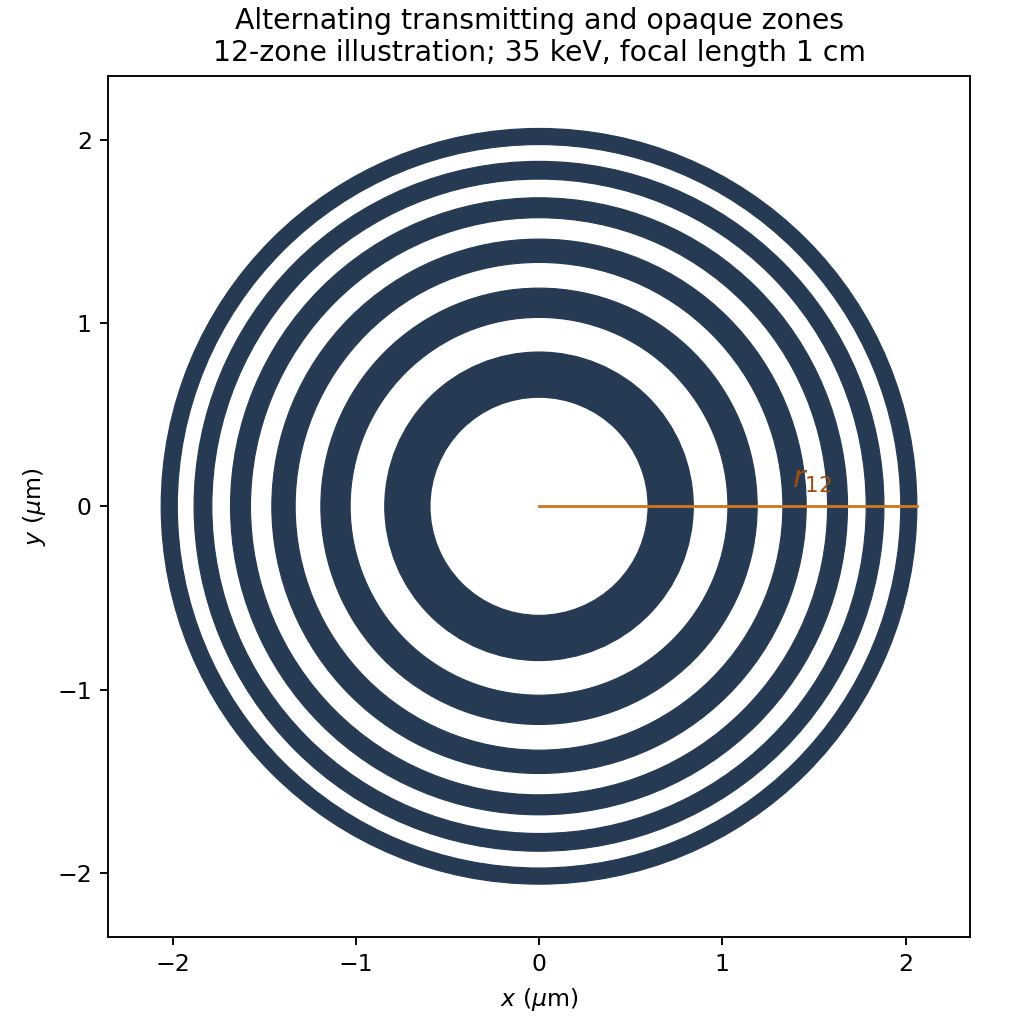

The blocking material must be sufficiently opaque at 35 keV; no attenuation coefficient or fabrication thickness is specified. A binary amplitude plate also has zero-order transmission and other odd-order foci, so an aperture/order stop may be needed. The principal focal length is chromatic, varying as for fixed radii.
New to topics? Read the docs here!