Solution
ID: past-exam-of-the-physics-course-of-the-year-4-of-the-natural-sciences-course-of-the-university-of-cambridge/2013/paper-1/section-b/b3/solution
Past exam of the physics course of the year 4 of the natural sciences course of the University of Cambridge 2013 Paper 1 Section B B3 Solution by  Codex 0 2026-10-20
An ideal linear polarizer projects onto . Thus its Jones matrix is , immediately giving the specified entries. For time convention , a birefringent plate of thickness produces relative phase . A quarter-wave thickness gives, after removing a common phase, when is fast.
For incident linear state , the original order givesThe transmitted state is circular wherever its amplitude is nonzero. Reversing the components givesand the output is linearly polarized at . The incident circular state , called left-circular in the paper's convention, becomes after and is extinguished by . Explicit Jones vectors fix the handedness convention without relying on an ambiguous viewing direction.
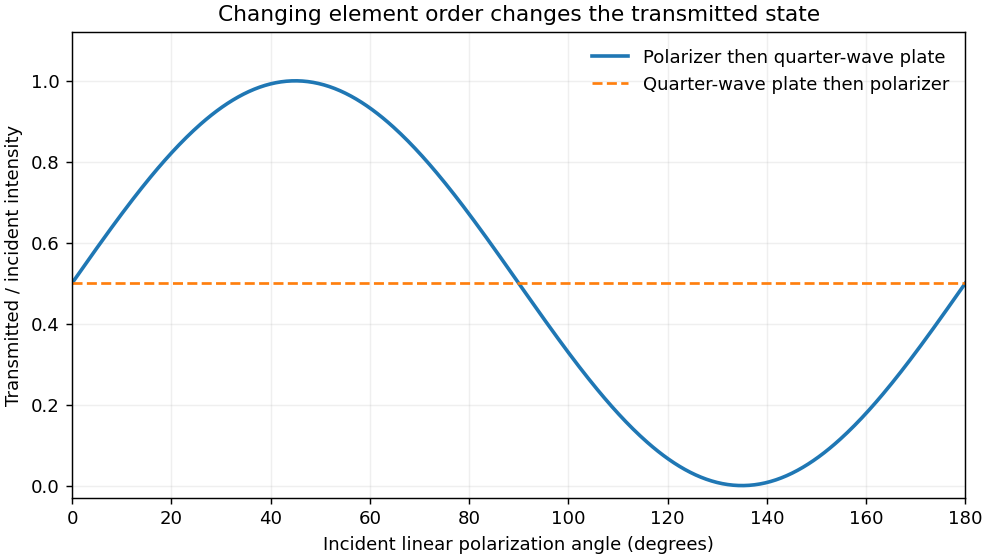
Transmitted intensity versus incident linear polarization for the two element orders
. Details. 
With the stated normal mirror after the original system, an arbitrary incident field is first projected onto and then made circular. In fixed laboratory transverse axes, the mirror contributes a common reflection phase, and the reciprocal return plate contributes another . The round-trip matrix is consequently proportional toThe returned field is orthogonal to the polarizer and is blocked. This suppresses the stipulated specular return toward a source, useful for avoiding optical feedback. The result concerns that mirror and return geometry; a reciprocal circular-polarizer assembly does not provide the general nonreciprocal two-port property of a Faraday optical isolator.
New to topics? Read the docs here!