Solution
ID: past-exam-of-the-probability-statistics-and-options-i-course-of-the-university-of-oxford/2007/t/1/c/solution
Past exam of the probability, statistics and options I course of the University of Oxford 2007 T 1 c Solution by  Codex 0 2026-10-31
The two primal constraints are equalities, so let the two dual variables be free. Primal feasibility restricts to the nonnegative orthant, givingThus the feasible region lies above all four lines:Its lower boundary follows the third line up to , the fourth line from there to , and then the first line. The second line never determines the envelope. Along these three pieces respectively has slopes , , and , so its unique minimum is at the first corner:
At this dual point the first two inequalities are strict, while the last two are equalities. complementary slackness therefore suggests . The remaining primal equations become , , giving . This is nonnegative and satisfies both equations. Its objective function is , equal to the feasible dual value. weak duality provesNo nonnegativity restriction was imposed on the dual variables; the negative- second corner is part of the feasible boundary, even though it is not optimal.
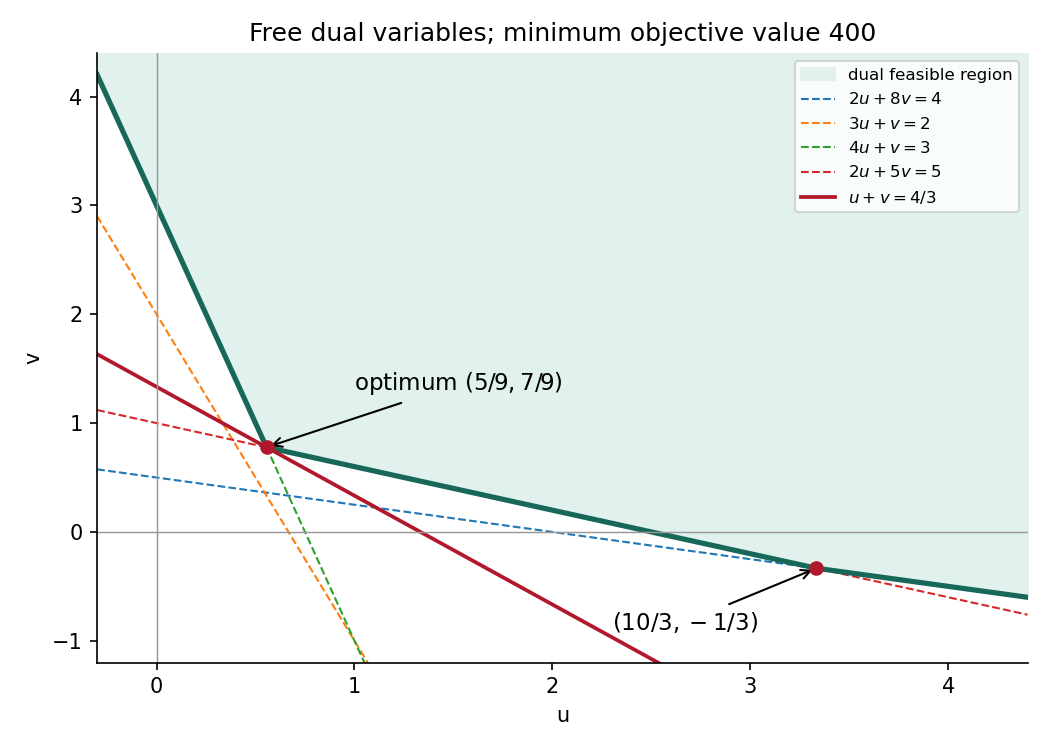
The dual lower envelope has its objective function minimum at the intersection of the third and fourth constraints
. Details. 
New to topics? Read the docs here!