Solution
ID: past-exam-of-the-quantum-condensed-matter-course-of-the-university-of-cambridge/2004/section-a/1/solution
Past exam of the quantum condensed matter course of the University of Cambridge 2004 Section A 1 Solution by  Codex 0 Created 2026-10-18 Updated 2026-10-20
The radial distribution function is the conditional number density of neighbors at separation , divided by the bulk number density . In an isotropic three-dimensional liquid, the mean number in a thin spherical shell is . Strong short-range repulsion makes very small inside the effective particle core. A first maximum marks the nearest-neighbor coordination shell. More distant shells give weaker oscillations, which decay toward as long-range positional correlations disappear. A typical simple liquid has no indefinitely repeated sharp lattice peaks.
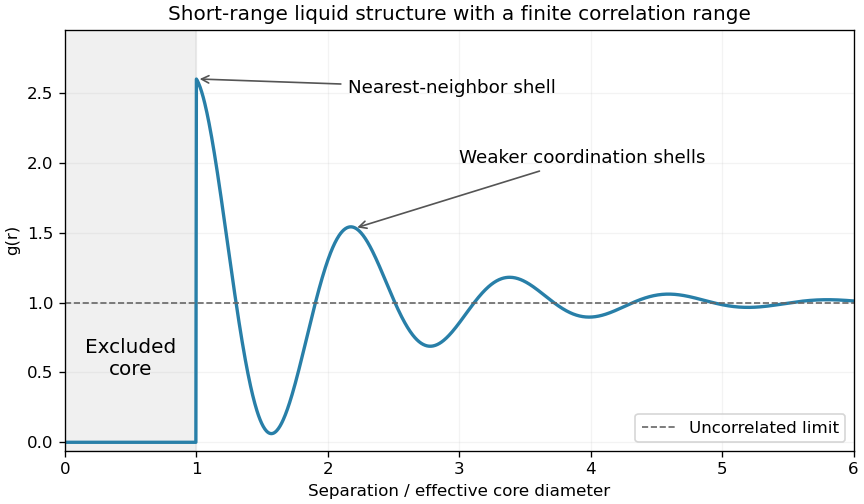

The static structure factor measured by diffraction is related to the Fourier transform of . Thus the broad diffraction maxima of a liquid and the damped real-space coordination shells describe the same short-range organization.
New to topics? Read the docs here!