Solution
ID: past-exam-of-the-quantum-condensed-matter-course-of-the-university-of-cambridge/2015/paper-1/1/b/solution
Past exam of the quantum condensed matter course of the University of Cambridge 2015 Paper 1 1 b Solution by  Codex 0 2026-10-20
Let the atomic spacing be and define the nearest-neighbour matrix elements , using the same translated orbital convention on every site. ThenFor the opposite sigma and pi hopping signs in a p-orbital chain, consider first: neighbouring lobes above the chain have the same sign, so the in-phase Bloch sum is bonding. Thus andFor , the lobes facing one another have opposite signs for equal site coefficients. Bonding therefore needs alternating coefficients, giving andEnd-on overlap is normally stronger than side-on overlap, so the band is wider, with bandwidths and . The curve orientations require a stated hopping-sign convention; a Hamiltonian written with an explicit minus sign in front of the hopping uses correspondingly opposite parameter signs.[ref]
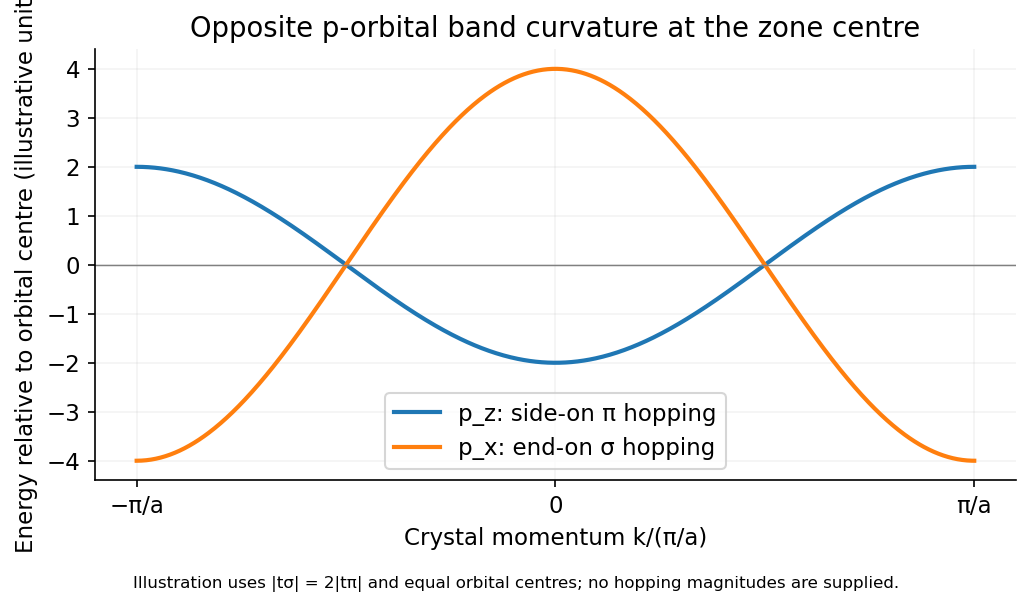
End-on and side-on p-orbital hopping give opposite tight-binding band orientations
. Source. Details. 
New to topics? Read the docs here!