Solution
ID: past-exam-of-the-quantum-information-course-of-the-university-of-cambridge/2012/paper-1/1/solution
Past exam of the quantum information course of the University of Cambridge 2012 Paper 1 1 Solution by  Codex 0 2026-10-20
Use the computational basis in the stated order and let the rightmost operation act first. The controlled phase gate is . From the rotation definition,The control-zero block remains the identity, and the control-one block becomes . ThusThis proves the relation for arbitrary superpositions, rather than only for computational-basis probabilities.
For the second relation write . Its central block is , with , . Because , and , direct multiplication givesMeanwhile . Multiplying these diagonal matrices and the overall factor givesThe supplied is indeed a square root of the SWAP gate: exchanges and while fixing the other basis states. It acts as one on the triplet subspace and as on the singlet subspace.
For an isotropic exchange interaction with Hamiltonian , define . Triplet and singlet energies differ by , soAn exchange pulse with therefore implements . Two such pulses, interspersed with the specified local rotations, implement the controlled phase gate; the initial and final target rotations then turn it into a CNOT gate. Their common overall phase has no effect on an isolated gate's outcome probabilities; a subsequently controlled version must keep track of conditional phases.
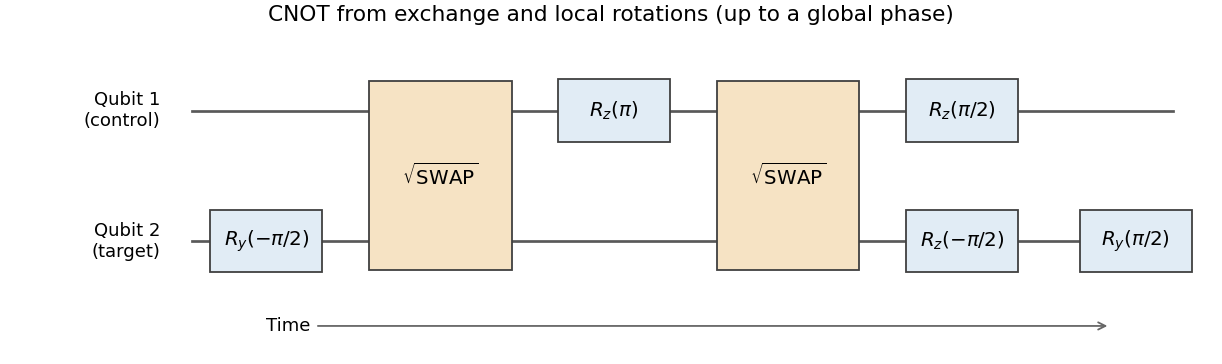
CNOT synthesis from two square-root-of-SWAP exchange pulses and local rotations, with time running left to right
. Details. 
The construction converts a physically available two-spin interaction into a standard entangling gate, which together with arbitrary one-qubit rotations supplies universal quantum computation. Practical operation needs calibrated exchange pulse area and timing, individually controllable rotations, and reproducible phase references. Charge noise can change ; magnetic-field gradients add unwanted single-spin evolution, and anisotropic exchange modifies the assumed Hamiltonian. Pulses must suppress leakage into unwanted orbital states while finishing before excessive decoherence. Readout, preparation, cross-talk and the extra operations in this decomposition all affect the achieved quantum gate fidelity. The algebraic identity alone does not establish a fault-tolerant quantum computation implementation.
New to topics? Read the docs here!