Solution
ID: past-exam-of-the-representation-theory-of-symmetric-groups-course-of-the-university-of-oxford/2011/3/d/solution
Past exam of the representation Theory of Symmetric Groups course of the University of Oxford 2011 3 d Solution by  Codex 0 2026-10-31
Track the first row after any prefix of the input permutation. Its th entry is the smallest possible final value of an increasing subsequence of length in that prefix. This minimum-tail invariant follows inductively from the row-insertion update.
Indeed, when a new value replaces the first first-row entry larger than it, at position , the previous entry in position is smaller than when . An increasing subsequence ending there can be extended by , so supplies a new attainable tail of length . It improves the old length- minimum. The minima for shorter lengths were already smaller than and remain unchanged; a longer subsequence ending at is impossible because its previous tail would have to be smaller than , contradicting the choice of . If no first-row entry exceeds , it appends and creates a new longest subsequence. This proves the invariant at every step.
In particular, the number of first-row cells is the maximum increasing-subsequence length. At the final tableau it is , soThis proves the required nonextension assertion, even without requiring the first-row tuple itself to occur as a subsequence.
That occurrence is not automatic for a general permutation. For example the word gives with rows . Its first-row tuple is not a subsequence of the word, because one occurs after three. The first row collects minimum tails for different subsequence lengths; those tails need not come from one common subsequence. If the source's premise is read as an additional hypothesis that the tuple does occur, the preceding maximum-length proof establishes its claimed maximality directly.
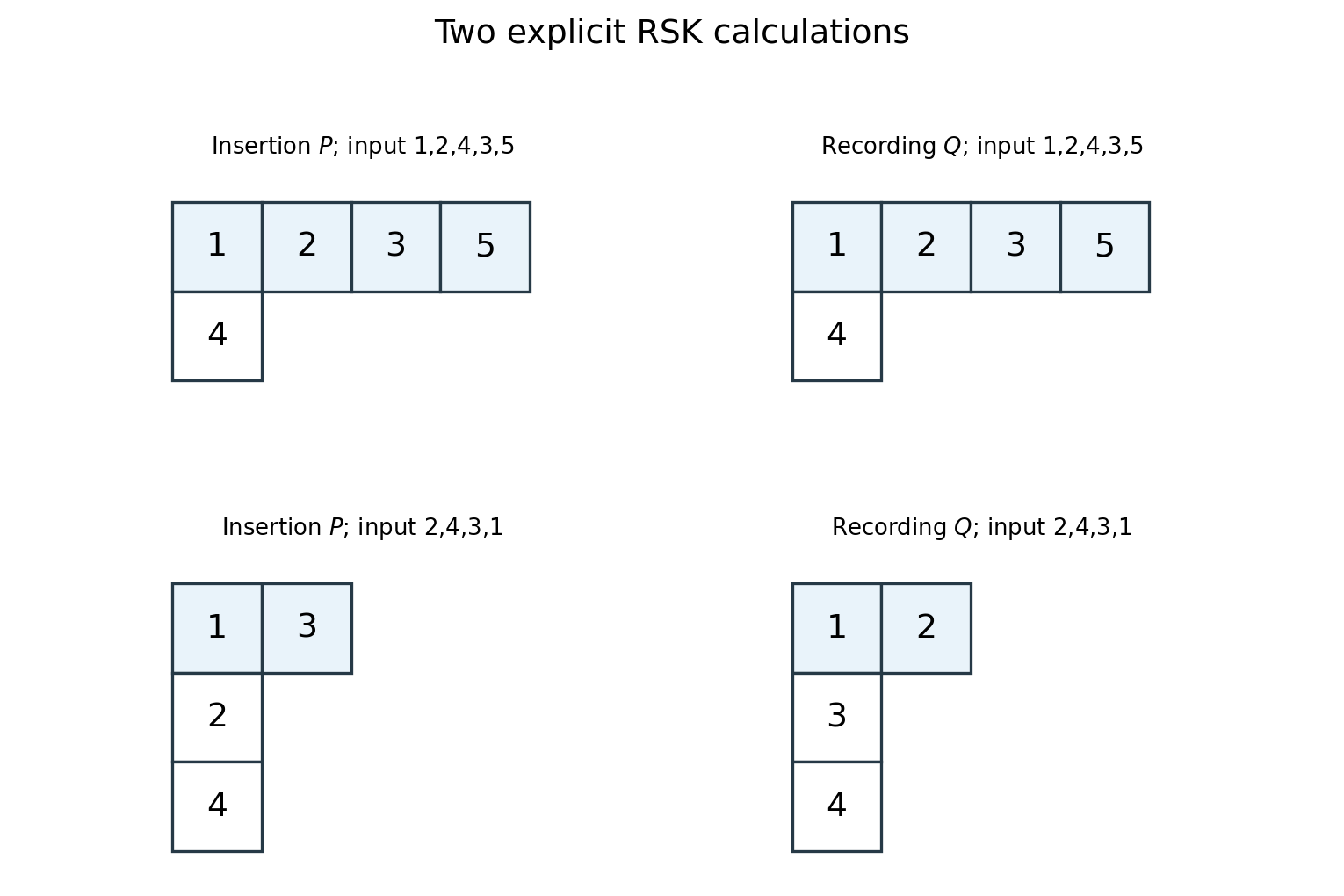
Two explicit row-insertion calculations and their recording tableaux
. The upper example is the adjacent transposition exchanging three and four, which gives identical insertion and recording tableaux of shape four plus one. The lower example has first insertion row one, three, although one occurs after three in its input word. Details.
The invariant is the first row of RSK as a minimum-tail table.
New to topics? Read the docs here!