Solution

ID: past-exam-of-the-short-options-paper-shared-by-prelims-and-parts-a-and-b-of-the-physics-course-of-the-university-of-oxford/2012/s12/2/1/solution

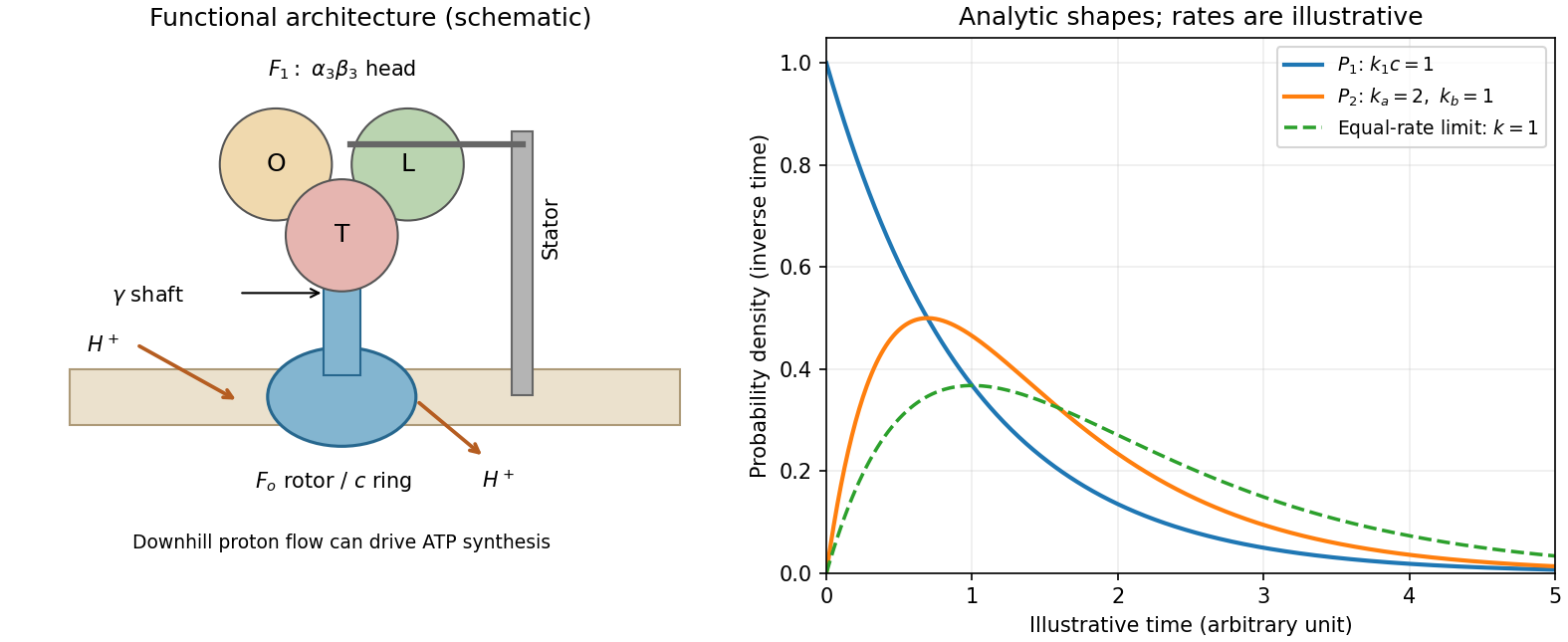
ATP synthase couples downhill proton motion across a cell membrane to synthesis of ATP from ADP and inorganic phosphate. Its membrane-embedded sector contains an subunit with offset proton-access half-channels and a rotating -subunit ring. Reversible protonation of sites on the ring permits rotation relative to the stationary subunit. The central rotor transmits this motion through the shaft to the soluble head. A peripheral stator holds the head relative to the membrane sector. The common bacterial schematic has an head, catalytic sites mainly on the three subunits, and a central rotor; accessory stator components depend on the organism.
The binding-change mechanism cycles the catalytic sites between open, loose-binding and tight-binding conformations. Rotor orientation changes their affinities for ADP, phosphate and ATP; the sites operate out of phase. Tight binding favors formation of bound ATP, and mechanical rotation changes the conformation to permit product release. In the ideal tightly coupled cycle, one revolution gives three catalytic turnovers:
The proton count is not universally fixed: an ideal ring with proton-carrying subunits gives protons per revolution and protons per synthesized ATP, before additional transport costs.
For a proton moving from side 1 to side 2, its molar electrochemical potential change is
The chemical gradient and membrane electric potential difference together supply the proton-motive force. Synthesis requires the proton free-energy release to meet the positive Gibbs free energy of ATP synthesis. The coupling is reversible: isolated supplied with ATP can hydrolyse it and rotate its shaft, while the intact enzyme can use hydrolysis-driven rotation to pump protons against their gradient. The sketch is structural and schematic; it does not reconstruct the absent stepping trace.
Figure 1.
ATP synthase architecture and the two derived dwell-time distributions
. The structural panel shows a membrane rotor, shaft, stator and three catalytic sites. The distribution panel uses explicitly illustrative dimensionless rates, not values read from the absent source stepping plot. Details.

New to topics? Read the docs here!