Solution

ID: past-exam-of-the-short-options-paper-shared-by-prelims-and-parts-a-and-b-of-the-physics-course-of-the-university-of-oxford/2015/s30/1/2/solution

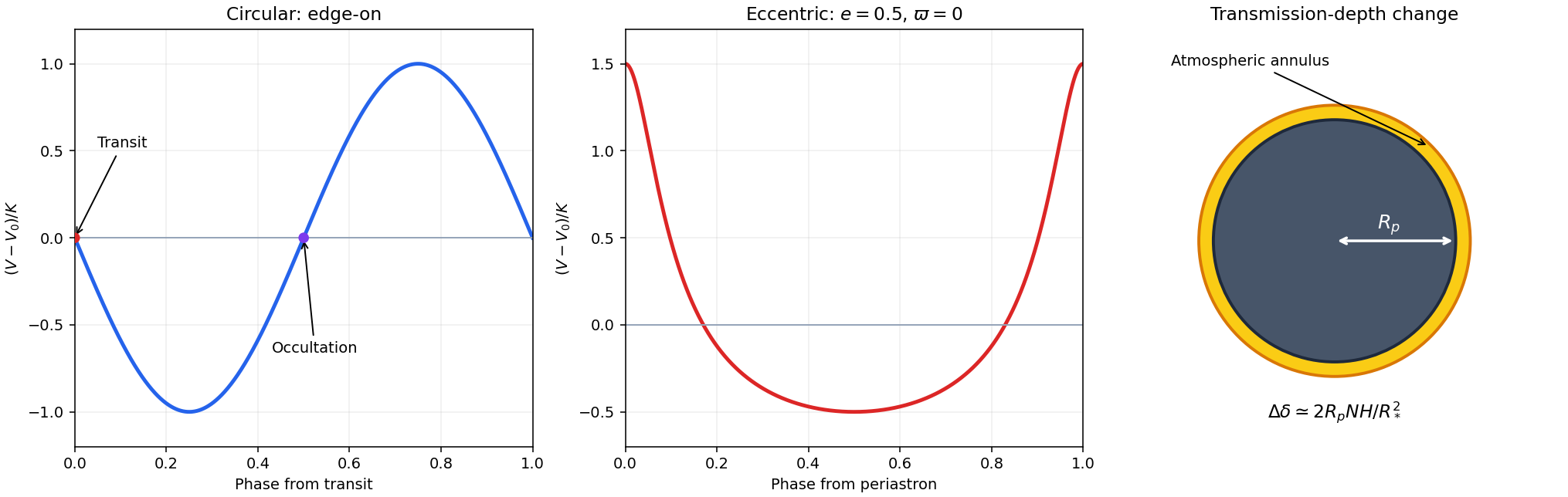
A circular orbit has uniform angular motion, so its Keplerian radial-velocity curve is sinusoidal. Choose phase , positive stellar velocity away from the observer, and an edge-on circular orbit. One consistent convention is
Transit occurs at the decreasing systemic-velocity crossing ; secondary eclipse is at the increasing crossing . Extrema occur one quarter of an orbit away. Reversing the velocity sign convention reverses the crossing directions but not the conjunction phases.
For an eccentric orbit, is not proportional to time. Solve , then use in the stated velocity relation. Motion is fastest near periastron, so the curve has an abrupt feature there and a more prolonged change near apastron, with its shape also depending on . It is not merely a shifted sinusoid. An eccentric transit need not coincide with , because the offset remains at conjunction.
Figure 1.
Circular and eccentric stellar radial velocities, and a transmission-spectrum annulus
. Original calculated velocity curves use a circular transit as phase zero on the left, and periastron as phase zero for the separate eccentric example with and . The right panel illustrates the projected area added by one atmospheric scale height; its atmospheric thickness is exaggerated for visibility. Details.

New to topics? Read the docs here!