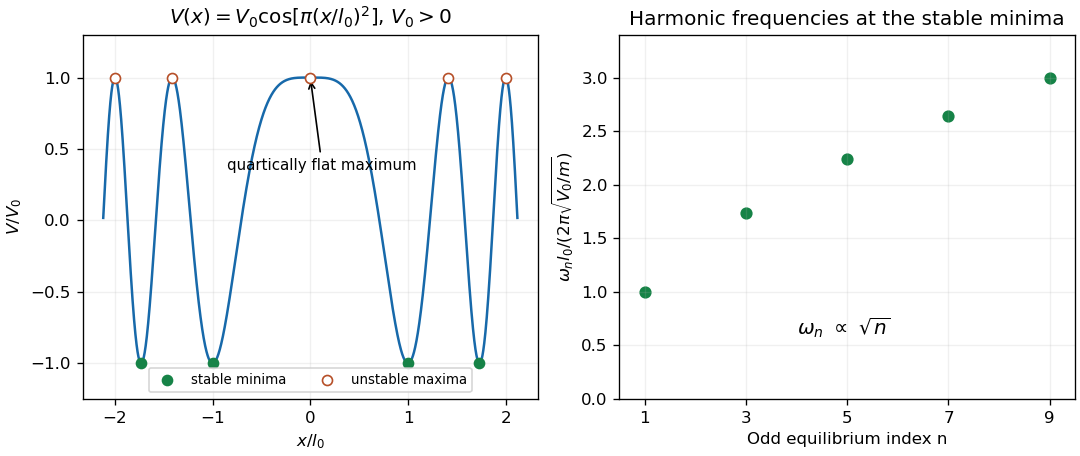
Write u=πx2/l02 and assume V0>0. The derivative of the potential is V′(x)=−2πV0xsinu/l02. Its equilibrium positions are zero and x=±l0n for positive integers n. At a nonzero equilibrium,
Even positive n give unstable maxima. At zero the quadratic term vanishes but V(x)=V0−V0π2x4/(2l04)+⋯, so the equilibrium is still unstable; a zero linearized frequency does not prove stability. If the unspecified sign of V0 were chosen negative, even-npositions would be stable instead, together with a degenerate quartic minimum at zero whose frequency tends to zero with oscillationamplitude.