Solution
ID: past-exam-of-the-soft-matter-and-biological-physics-course-of-the-university-of-cambridge/2015/paper-1/2/c/solution
Past exam of the soft matter and biological physics course of the University of Cambridge 2015 Paper 1 2 c Solution by  Codex 0 2026-10-20
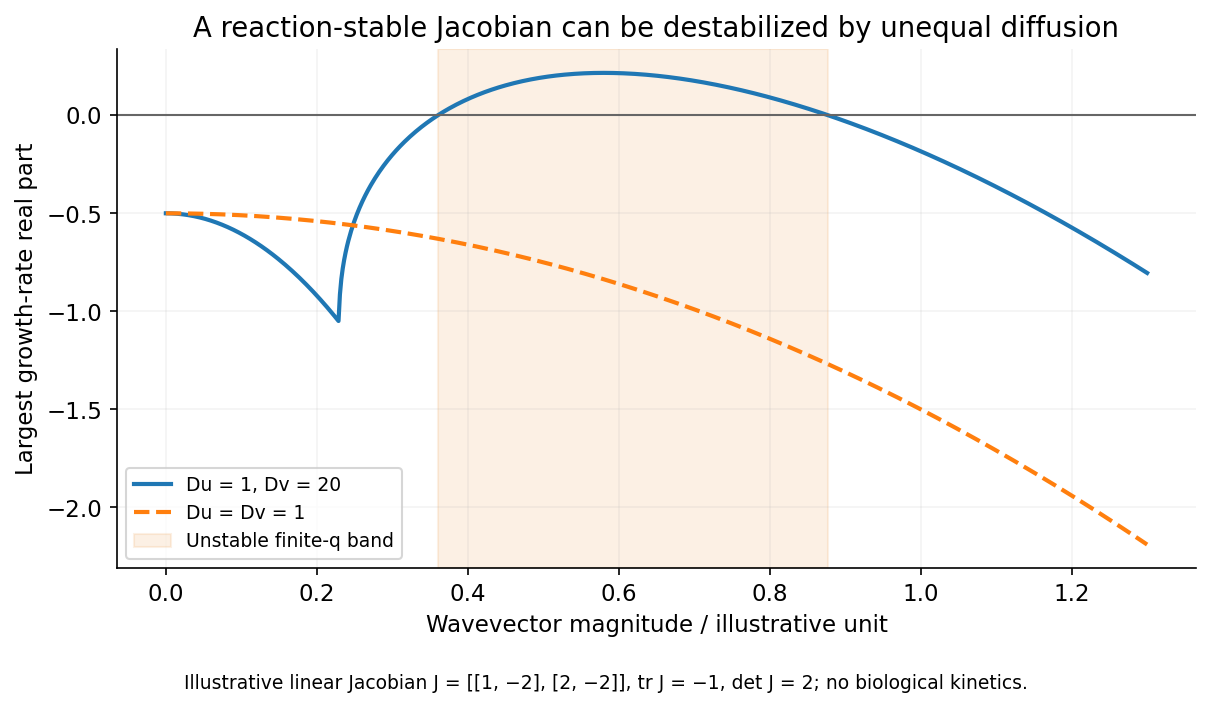
A generic chemical reaction–diffusion system couples local kinetics to spatial transport:A homogeneous stationary state satisfies . Let its reaction Jacobian be . Local well-mixed stability requires and . A Fourier perturbation of wavevector magnitude evolves under , whose determinant isSince its trace remains negative, a diffusion-driven stationary instability appears if the determinant becomes negative for some allowed wavevector. In a spatially large domain the conditions areTogether with reaction-only stability, these give a finite unstable wavelength range. Equal diffusion coefficients cannot generate this instability: they simply shift each reaction eigenvalue by . On a finite domain, an admissible spatial eigenmode must actually lie in the unstable band. Nonlinearities then determine saturation and whether a predicted pattern is stable, so a linear unstable band alone does not calculate a final pattern.[ref]
Other kinetics support travelling fronts or oscillatory waves rather than a stationary pattern. For instance, the scalar abstract equation has a pulled-front speed for a sufficiently steep invading initial profile. Here it is used as an abstract kinetics-and-diffusion example, without a biological interpretation. The ratio of diffusion time to reaction time characterizes whether spatial mixing is rapid enough to justify a well-mixed model.

New to topics? Read the docs here!