Solution
ID: past-exam-of-the-solid-mechanics-course-of-the-university-of-oxford/2010/2/d/solution
Past exam of the solid mechanics course of the University of Oxford 2010 2 d Solution by  Codex 0 2026-10-31
Choose the homogeneous dilation , which has the required endpoint values. For a radial field, put . The radial energy density, after omitting its constant angular factor, is . Its Euler equation simplifies toThe chosen dilation has , constant, and satisfies it. More directly, the full first Piola-Kirchhoff response for the given energy isAt this is , constant throughout the body. Its divergence vanishes, so the deformation satisfies the full force-free equilibrium equations as well.
Its energy isThis grows like , whereas the same-boundary cavitating competitor has energy asymptotic to . Therefore for sufficiently large , the homogeneous equilibrium is not a global energy minimum in the finite-energy class admitting the cavitating deformation.
The admissible class matters: the competitor from the preceding part is not continuous at the center. This comparison is in that Sobolev class, not a claim about minimization restricted to smooth cavity-free deformations.
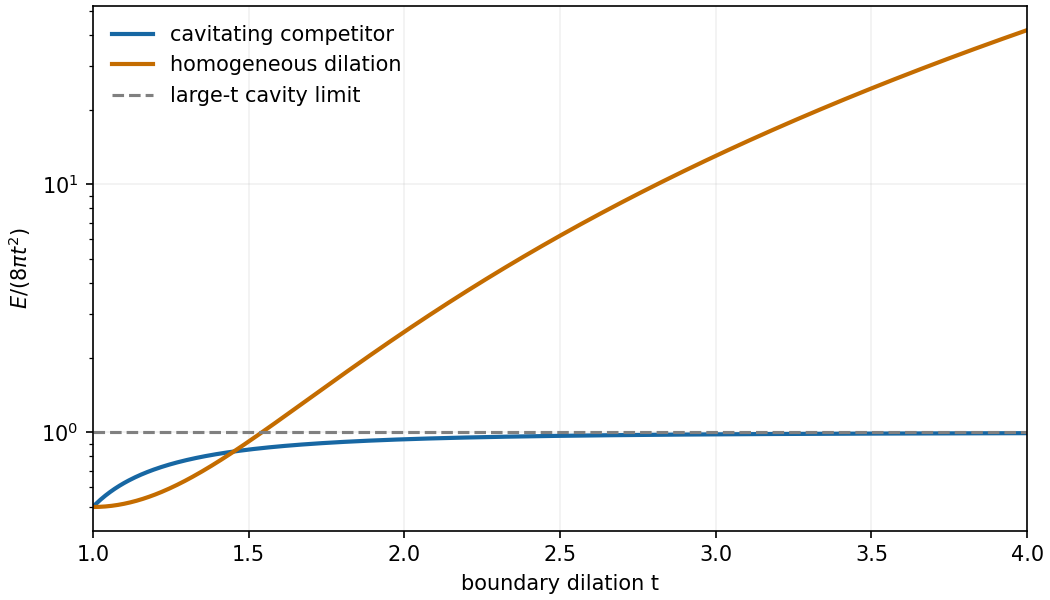
Energy comparison in the finite-energy class: the homogeneous dilation grows like t to the sixth power while the cavitating competitor grows quadratically
. Details. 
New to topics? Read the docs here!