Solution
ID: past-exam-of-the-sub-atomic-physics-course-of-the-university-of-oxford/2016/2/c/b/solution
Past exam of the sub-atomic physics course of the University of Oxford 2016 2 c b Solution by  Codex 0 2026-10-25
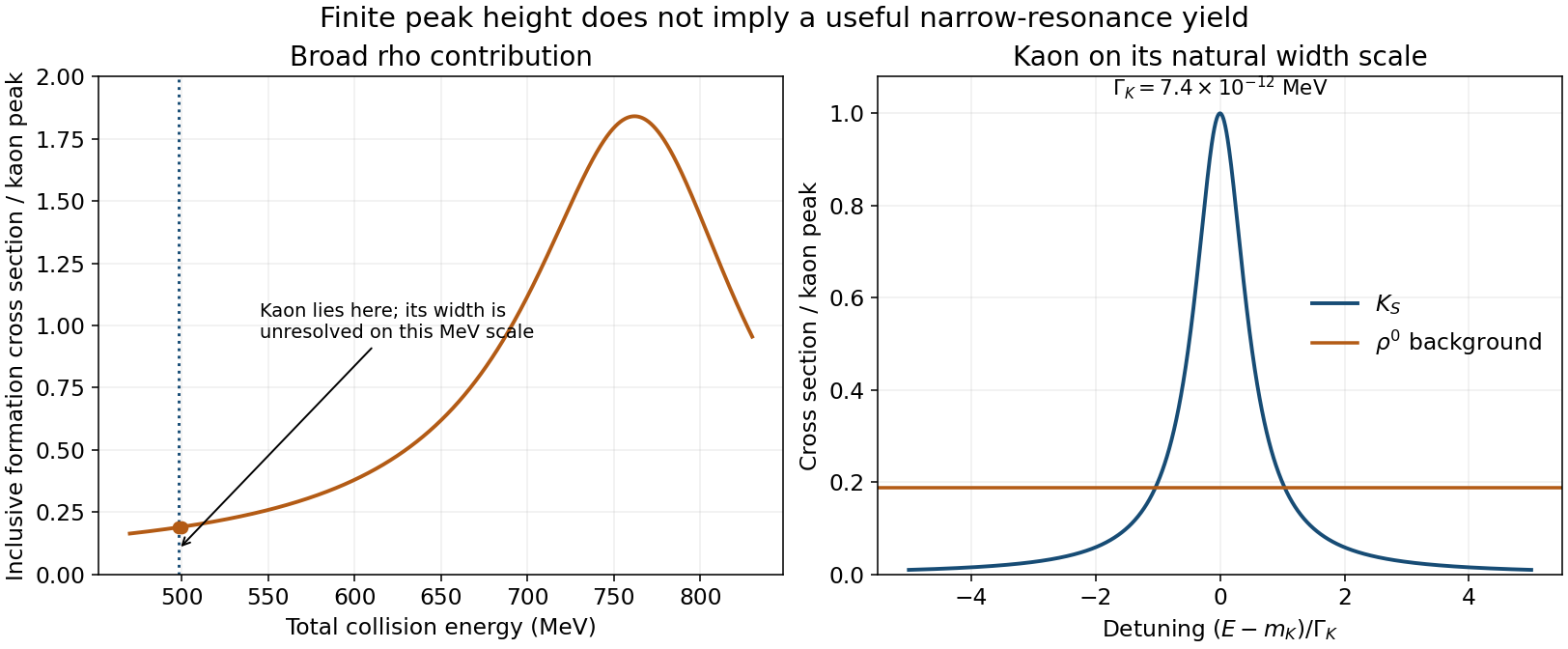
Raising each beam energy to 250 MeV makes MeV. The kaon denominator is now dominated byrather than by . Substituting into a givesThe enormous change is a tiny-width effect, not a comparably abrupt change in the broad rho contribution. The center-of-momentum energy has moved about kaon widths from the peak. A width of MeV is only eV, requiring an energy-selection scale of order relative to the several-hundred-MeV beam energy.
Real beams have vastly broader energy distributions. Averaging over such a distribution suppresses the useful narrow-resonance contribution: the finite peak value does not imply a large energy-integrated formation rate, whose resonant area shrinks with the width at fixed branching fractions. The weak inverse-decay entrance coupling and the broad strong-interaction rho background therefore make this a poor way to study kaon resonant formation. The supplied broad-resonance formula is used algebraically as requested; a practical calculation would convolve an appropriate narrow line shape with the actual beam distribution.

New to topics? Read the docs here!