Solution
ID: past-exam-of-the-systems-biology-course-of-the-university-of-cambridge/2024/paper-3/3/d/solution
Past exam of the systems biology course of the University of Cambridge 2024 Paper 3 3 d Solution by  Codex 0 2026-10-20
Add the activating link from to and multiply the two Hill activation functions for the target:The extra Hill constant has units of concentration and is its Hill coefficient. Both inputs are required for substantial target production: if either is zero, the production term for vanishes. This all-activating circuit is a coherent feed-forward loop. A product of graded input functions implements the specified AND rule; it is a phenomenological rule rather than a complete molecular promoter model.
Retain the parameter values of parts (b) and (c), and set , . Continue the same Python script with the altered right-hand side:
def and_rhs(state, X):
    Y, Z = state
    return np.array([2*hill(X, 1, 2) - Y,
                     3*hill(X, 2, 4)*hill(Y, 1, 4) - Z])

times = np.linspace(0, 10, 1001)
plt.figure(figsize=(7, 4))
for X in [1, 3]:
    trajectory = integrate(lambda s: and_rhs(s, X), [0, 0], times)
    plt.plot(times, trajectory[:, 0], "--", label=f"Y, X={X}")
    plt.plot(times, trajectory[:, 1], label=f"Z, X={X}")
plt.xlabel("Time")
plt.ylabel("Concentration")
plt.legend()
plt.tight_layout()
plt.show()
At , and . At , and . In both simulations first accumulates and opens the additional gate; therefore initially grows more slowly than under direct activation alone. The equilibrium concentration of is unchanged by the added outgoing interaction.
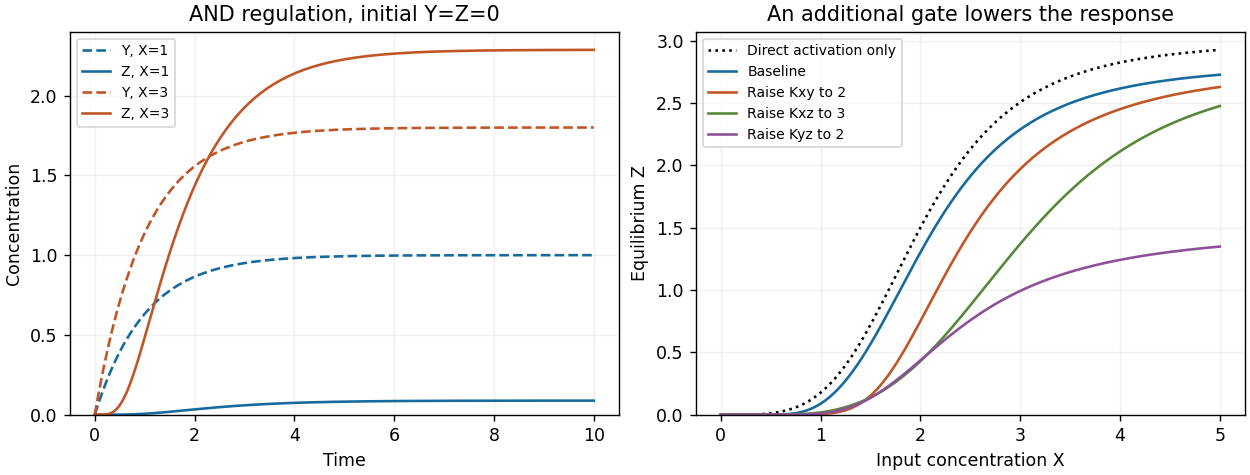
AND feed-forward dynamics and the effect of activation thresholds
. The left panel compares fixed inputs X=1 and X=3 from the zero state. The right panel compares the full feed-forward equilibrium response with direct activation alone and with individual Hill constants increased. Details.
New to topics? Read the docs here!