Solution
ID: past-exam-of-the-theoretical-physics-i-course-of-the-university-of-cambridge/2014/paper-1/6/c/solution
Past exam of the theoretical physics I course of the University of Cambridge 2014 Paper 1 6 c Solution by  Codex 0 2026-10-20
Set and . The trial density is . At fixed , its minimum is if and otherwise, with density . Minimizing usesFor , minimizes the quadratic coefficient. For , the minima are at and have . ThusEverywhere else the minimum is ; at the transition boundary the ordered amplitude tends to zero. The zero-field minimum is respectively or in the two ordered regions. For the helical solution is lower than a uniform ordered extremum whenever the latter exists, and lower than the disordered state whenever its amplitude is nonzero. The assumed positive-amplitude ansatz must allow its zero-amplitude boundary to describe disorder.
The phase remains arbitrary because the functional has global U(1) symmetry. At nonzero , a translation shifts that phase; separate translation and phase operations retain a combined unbroken subgroup. The two signs of also select opposite handedness. The meeting point of the uniform, modulated and disordered mean-field regions is the Lifshitz point .
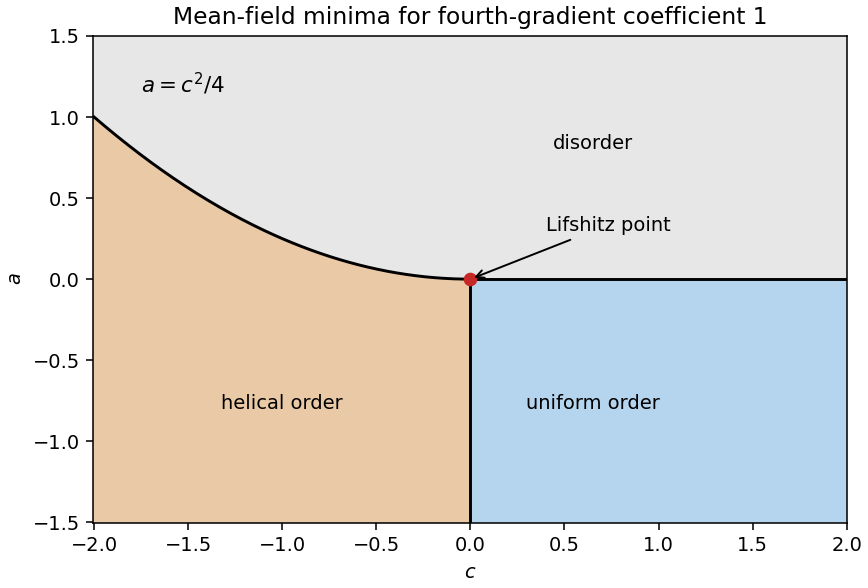
Uniform, helical and disordered minima of the specified complex Landau free energy
. Details. 
New to topics? Read the docs here!