Solution
ID: past-exam-of-the-theoretical-physics-ii-course-of-the-university-of-cambridge/2016/paper-1/3/e/solution
Past exam of the theoretical physics II course of the University of Cambridge 2016 Paper 1 3 e Solution by  Codex 0 2026-10-20
A linear number-difference energy gives only a one-body level renormalization. Let , with . Then is constant, so the exchange coefficient cancels. Since ,The same-direction commutators vanish as well, so this is the whole second-order term. This agrees with expanding the two-site single-particle splitting with the appropriate assignment of levels. A collection of noninteracting bosons remains noninteracting after a change of single-particle basis. The case is resonant and cannot be treated by this elimination.
A nonlinear energy generally makes the virtual denominators occupancy-dependent. Then and need not agree, and the occupancy-preserving effective Hamiltonian contains density-dependent shifts and a spin-exchange coefficientmultiplying . Its sign depends on the function and sector; nonlinearity alone does not fix a universal exchange sign. The full second-order result can additionally contain pair hopping between different occupation sectors.
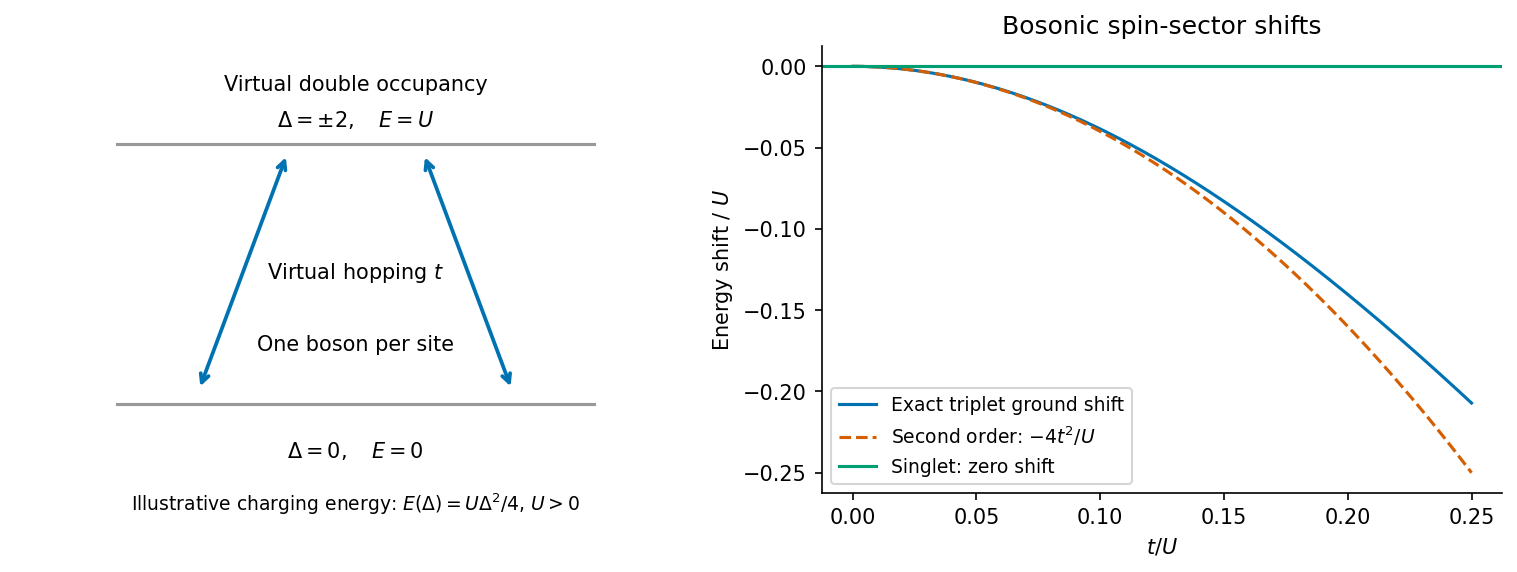
For a concrete repulsive example, take , , and restrict to two bosons with one on each site. Here , , , givingThe triplet energy shift is and the singlet shift is zero. This is ferromagnetic bosonic superexchange in this example: the symmetric spin sector can lower its energy through virtual double occupancy. The sign must not be imported from the fermionic Hubbard problem. The example specifies an additional energy function solely to illustrate the general expression; it is not an asserted numerical input.

New to topics? Read the docs here!