Solution
ID: past-exam-of-the-theoretical-physics-major-option-course-of-the-university-of-oxford/2016/4/d/solution
Past exam of the theoretical physics major option course of the University of Oxford 2016 4 d Solution by  Codex 0 2026-10-25
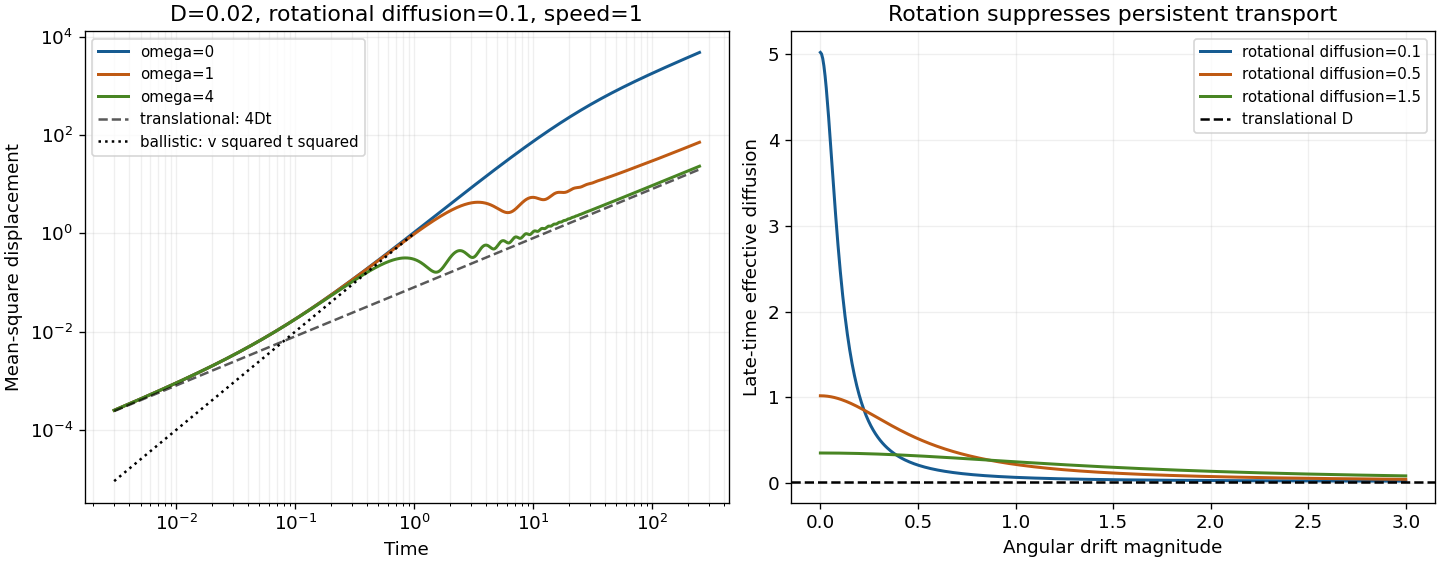
For , expand the exact expression:At asymptotically short time, translational diffusion dominates if . A ballistic window occurs when , provided these scales are separated. The swimmer then retains nearly constant direction.
For and , the oscillatory exponential decays andAt intermediate times, the angular drift bends persistent trajectories into arcs. If , several rotations occur before orientational decorrelation, producing oscillatory shoulders rather than a long straight ballistic regime. In the limit , , the active contribution is bounded and periodic: . At , it remains ballistic forever, so ordinary late-time active diffusion does not follow.

New to topics? Read the docs here!