Solution
ID: past-exam-of-the-topics-in-applied-mathematics-course-of-the-university-of-oxford/2009/a/1/b/i/solution
Past exam of the topics in applied mathematics course of the University of Oxford 2009 A 1 b i Solution by  Codex 0 2026-10-31
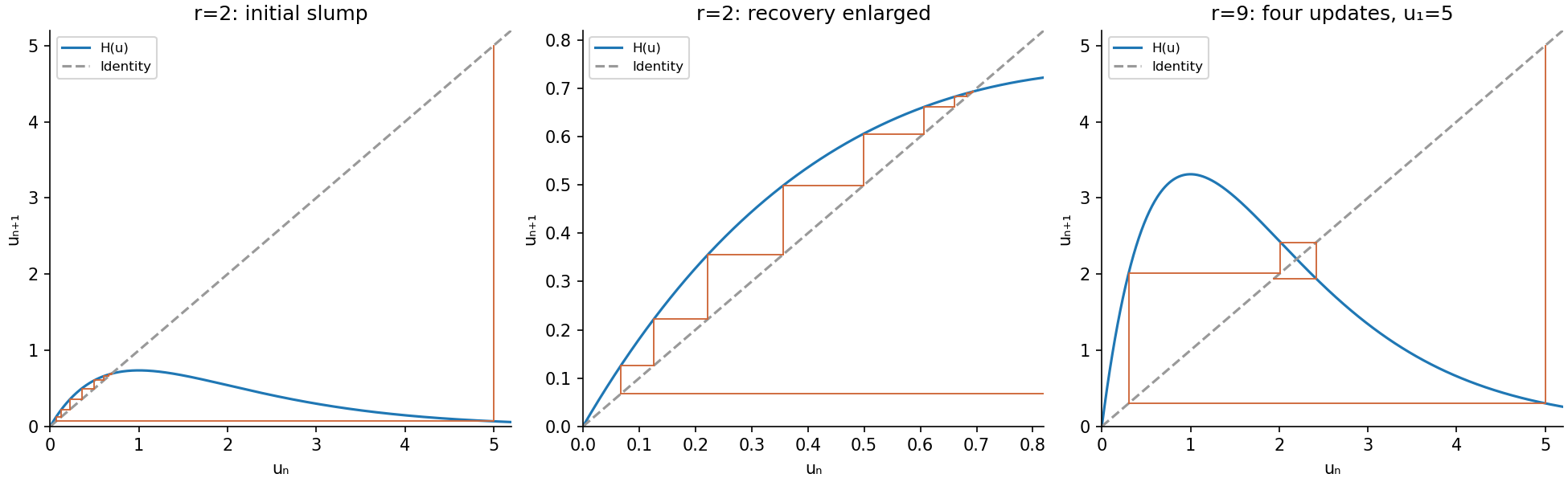
A large initial biological population maps to a very small positive biological population because at large : the initial slump is followed by recovery. Cobwebbing alternates a vertical step from to with a horizontal step to the diagonal at . The figure uses the explicit illustrative choice .
For , every positive orbit subsequently lies below the maximum . On the map is increasing, with the unique positive fixed point . Below that point and ; above it and . Therefore the trapped iterates approach the fixed point monotonically from whichever side they enter. In particularThe extinction initial value remains zero, but exact extinction is never reached from a positive finite biological population in this deterministic model.

New to topics? Read the docs here!