Solution
ID: past-exam-of-the-topics-in-applied-mathematics-course-of-the-university-of-oxford/2010/a/2/c/i/solution
Past exam of the topics in applied mathematics course of the University of Oxford 2010 A 2 c i Solution by  Codex 0 2026-10-31
The equal-diffusivity Fisher reduction uses equal diffusion coefficients and the invariant relation . The second equation then requires , while the first becomes . They agree whenThis reduction requires compatible initial and boundary data on that invariant relation. Tuning a parameter alone does not force arbitrary solutions of the two-field system onto it. For positive physical , the displayed normalization also requires . More generally the line works when ; the same positivity restriction remains for .
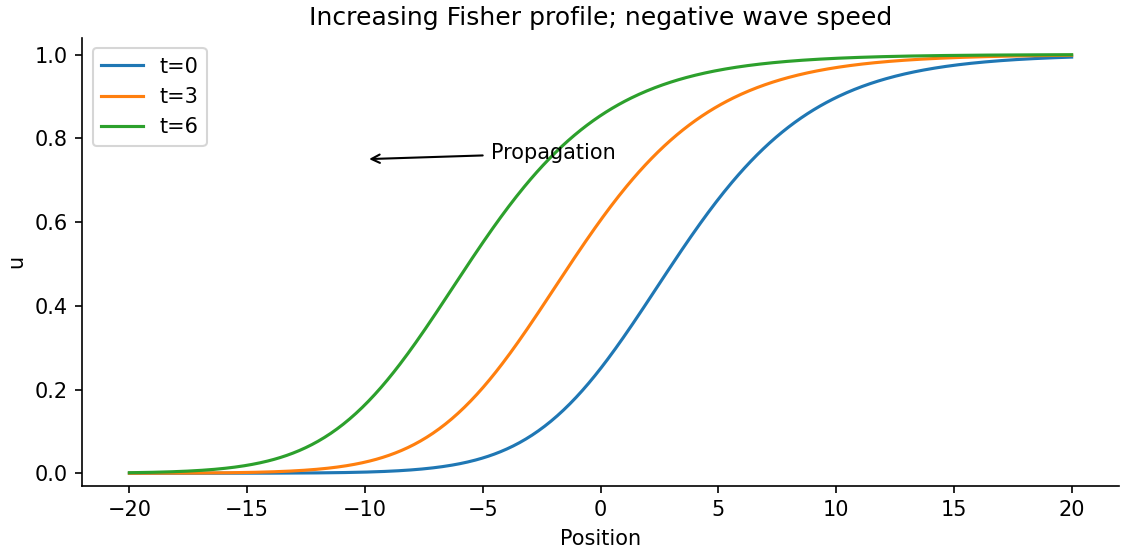
Let and with , . The profile equation is . Multiplication by and integration givesConsequently : the increasing front moves left, with the state invading . Linearization at its leading edge gives real monotone exponents only when , yielding the usual Fisher front speed range. A convenient exact example isSubstitution verifies it and the figure shows its leftward displacement. The source uses for the end limits after defining ; they denote the same spatial coordinate here.

New to topics? Read the docs here!