Solution
ID: past-exam-of-the-topology-and-groups-and-algebraic-topology-course-of-the-university-of-oxford/2007/b/5/solution
Past exam of the topology and Groups and Algebraic Topology course of the University of Oxford 2007 B 5 Solution by  Codex 0 2026-10-31
Choose an orientation for each simplex. The chain group is the free abelian group on the oriented -simplices, with orientation reversal changing sign. On an ordered simplex setIts face maps respect the identifications in a Delta-complex. In , deleting any pair of vertices occurs in the two possible orders with signs and , which cancel. Hence . The groups of homological cycles and boundaries are and ; the identity just proved gives , so is defined. Mod-two homology uses the same chain complex with coefficients reduced modulo two.
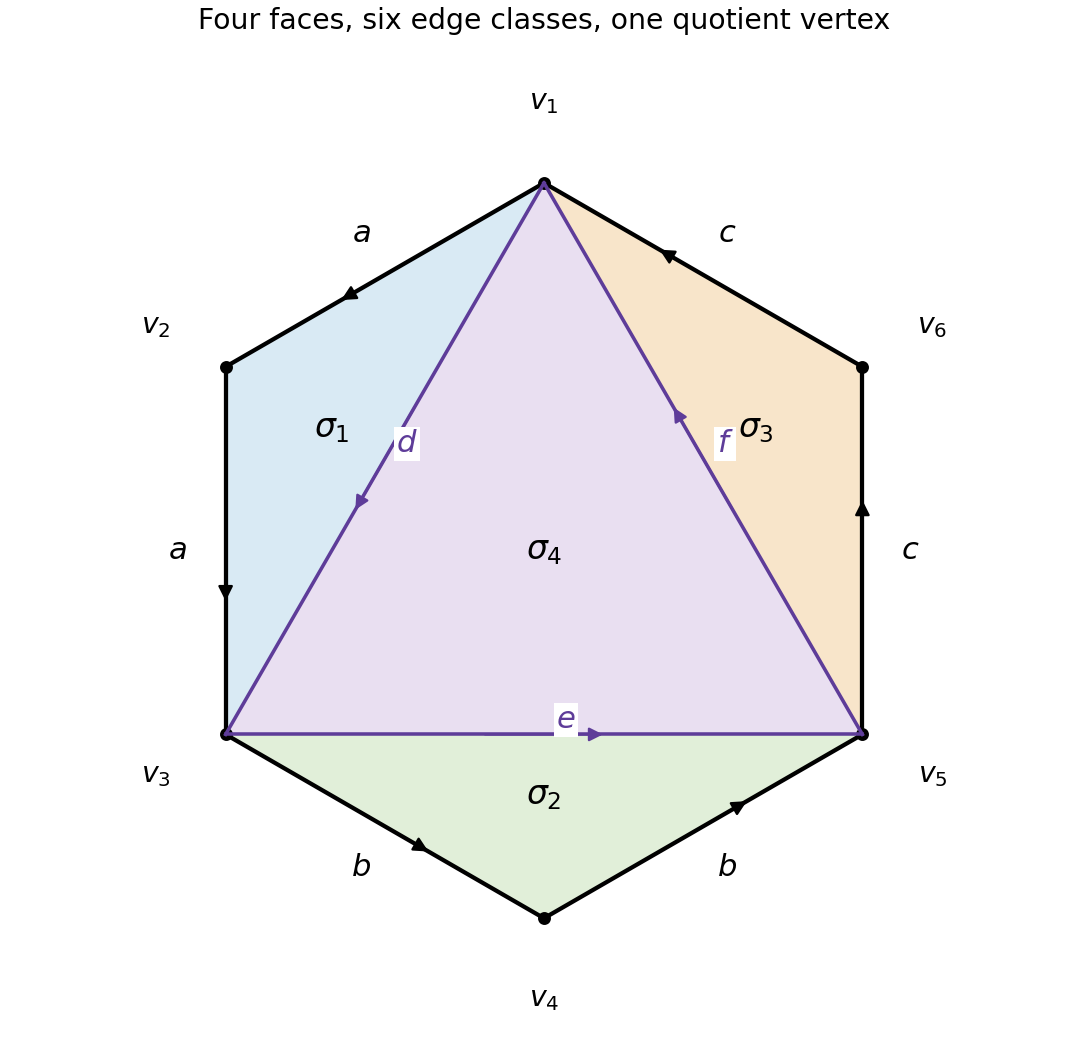
Here the edge identifications put all six vertices into one vertex class. Let the three boundary edge classes be in cyclic order, and orient the internal diagonals as , , . With the four face orientations listed in the source, the boundaries areThus , , , and . The Euler characteristic isThe face-boundary map is injective over the integers: coefficients of force the first three face coefficients to vanish, after which the diagonal coefficients force the fourth to vanish. Its cokernel eliminates and leaves generators with the single relation . Since is primitive in , this cokernel is . ThereforeModulo two the first three face-boundary columns are , and the last is their sum. The rank is three, the kernel is one-dimensional, and the edge quotient has dimension three. ConsequentlyThe top mod-two class is the sum of all four faces. Integral homology has no such top class, reflecting nonorientability.

New to topics? Read the docs here!