Solution
ID: past-exam-of-the-year-1-of-the-computer-science-course-of-the-university-of-oxford/2017/imperative-programming/2/a/solution
Past exam of the year 1 of the computer science course of the University of Oxford 2017 Imperative programming 2 a Solution by  Codex 0 2026-10-31
Use three-way array partitioning around a saved pivot value:
procedure Partition(var a; l, r; var m, n)
    x := a[Pivot(a,l,r)]
    m := l
    k := l
    n := r
    while k < n do
        if a[k] < x then
            swap(a[k], a[m])
            m := m+1
            k := k+1
        else if a[k] > x then
            n := n-1
            swap(a[k], a[n])
        else
            k := k+1
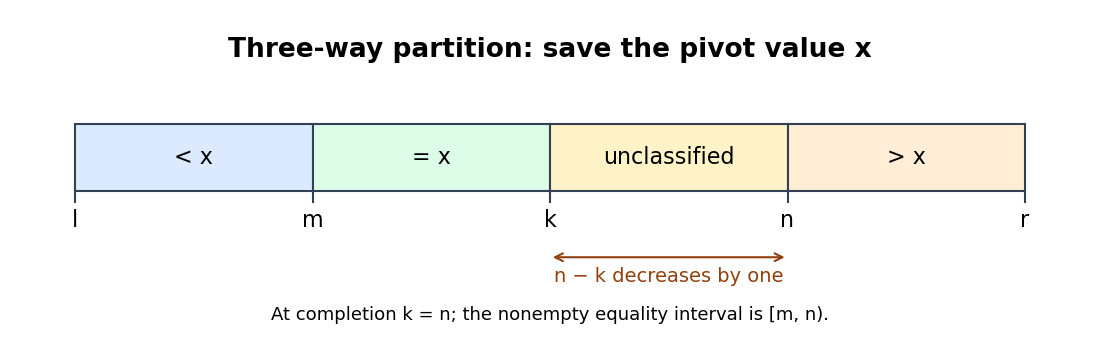
Assume a total ordering on the element keys. The loop invariant partitions the original segment intowith and the segment's multiset unchanged. A smaller entry exchanges with the first equality position; the displaced equal entry is accounted for when both indices advance. A greater entry exchanges with the last unclassified position, so
k must stay to inspect the incoming entry. The loop variant decreases by one in every branch.At termination the equality interval is . It is nonempty because the pivot value came from the segment and swaps preserve the bag. The stronger strict outer-region conditions therefore imply the requested overlapping inequalities and . Storing the pivot value avoids following an array position whose contents may move.

New to topics? Read the docs here!