Solution
ID: past-exam-of-the-year-1-of-the-computer-science-course-of-the-university-of-oxford/2017/imperative-programming/5/d/solution
Past exam of the year 1 of the computer science course of the University of Oxford 2017 Imperative programming 5 d Solution by  Codex 0 2026-10-31
Add one concrete decorator and a small application:
class Sports(account: CableTV) extends Packages(account) {
  override def cost: Double = super.cost + 5.0
  override def packages: String = super.packages + ", Sports"
}

object CableTVExample extends App {
  val basic: CableTV = new BasicPlan
  val movies: CableTV = new Movies(basic)
  val hd: CableTV = new HDChannels(movies)
  val sports: CableTV = new Sports(hd)
  Seq(basic, movies, hd, sports).foreach { account =>
    println(account.packages + " = £" + account.cost)
  }
}
The output is:
Basic plan = £30.0
Basic plan, Movies = £40.0
Basic plan, Movies, HD channels = £47.0
Basic plan, Movies, HD channels, Sports = £52.0
The final price is £52. Each new wrapper leaves earlier account objects available at their original prices. In the UML class diagram, both
BasicPlan and Packages realize CableTV; each package class inherits Packages. The account relationship points from the decorator to another CableTV component. It is an association, without asserting exclusive lifetime ownership.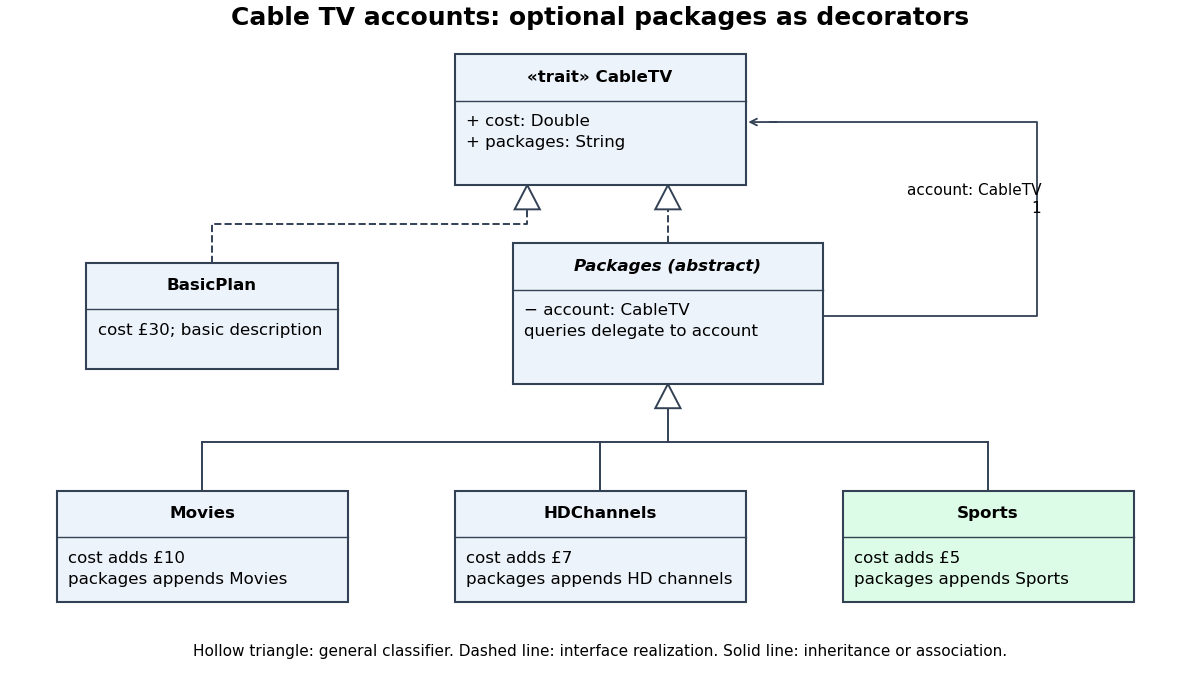
Cable TV decorator classes extended with the Sports package
. Original UML class diagram. Dashed hollow-triangle arrows denote interface realization; solid hollow-triangle arrows denote class inheritance. The account association permits nested decorators. Details.
New to topics? Read the docs here!