Solution
ID: past-exam-of-the-year-1-of-the-computer-science-course-of-the-university-of-oxford/2018/discrete-mathematics-continuous-mathematics-and-probability/6/d/solution
Past exam of the year 1 of the computer science course of the University of Oxford 2018 Discrete mathematics, continuous mathematics, and probability 6 d Solution by  Codex 0 2026-10-31
The printed inequality has its sign reversed: for . This is present in the original scan, rather than arising in transcription. For , Taylor's theorem with Lagrange remainder givesPart (a) has , so the remainder is strictly negative. As an independent check, direct algebra gives the quadratic Taylor majorant of a reciprocal quadratic:For example, is already a counterexample to the requested direction. The exact identity also shows that this polynomial majorizes on the entire real line, with equality only at one.
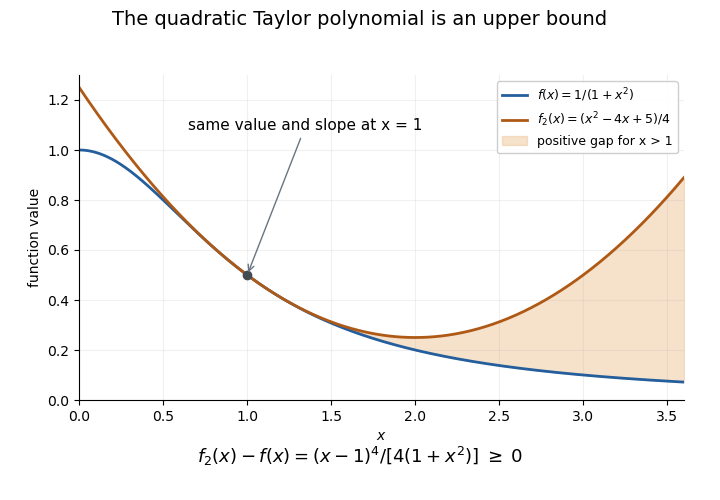
The quadratic Taylor polynomial lies above the reciprocal quadratic, correcting the printed inequality
. The shaded gap for is positive and equals . Details.
New to topics? Read the docs here!