Solution
ID: past-exam-of-the-year-1-of-the-computer-science-course-of-the-university-of-oxford/2021/imperative-programming-resit/2/e/solution
Past exam of the year 1 of the computer science course of the University of Oxford 2021 Imperative programming (resit) 2 e Solution by  Codex 0 2026-10-25
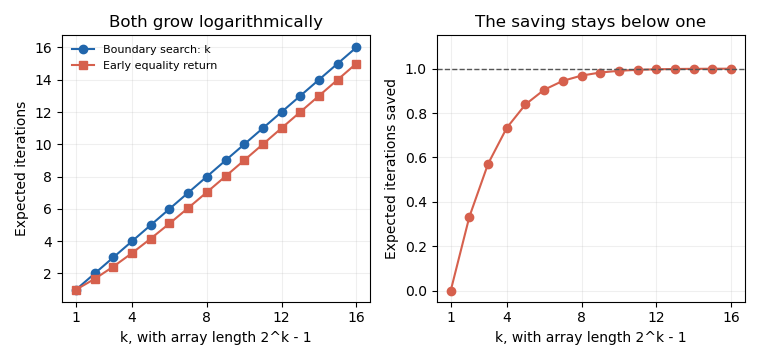
The expected saving on the specified successful searches iswhich tends to one iteration as increases. The fractional saving is , which tends to zero. Both versions have logarithmic expected time, and the improvement is a bounded average saving rather than a change of growth rate. A target at the first middle position benefits greatly, but the uniform distribution does not concentrate on that event. The extra equality branch and machine-level costs also matter when comparing measured execution times.

New to topics? Read the docs here!